Artificial intelligence has moved far beyond being a futuristic concept or an experimental technology. Over the past few years, it has become an integral part of how businesses operate, make decisions, and deliver value to customers. While many organizations are still exploring ways to integrate AI into their existing processes, a new generation of companies is emerging with a fundamentally different approach. These organizations are not simply adopting artificial intelligence—they are building their businesses around it from day one.
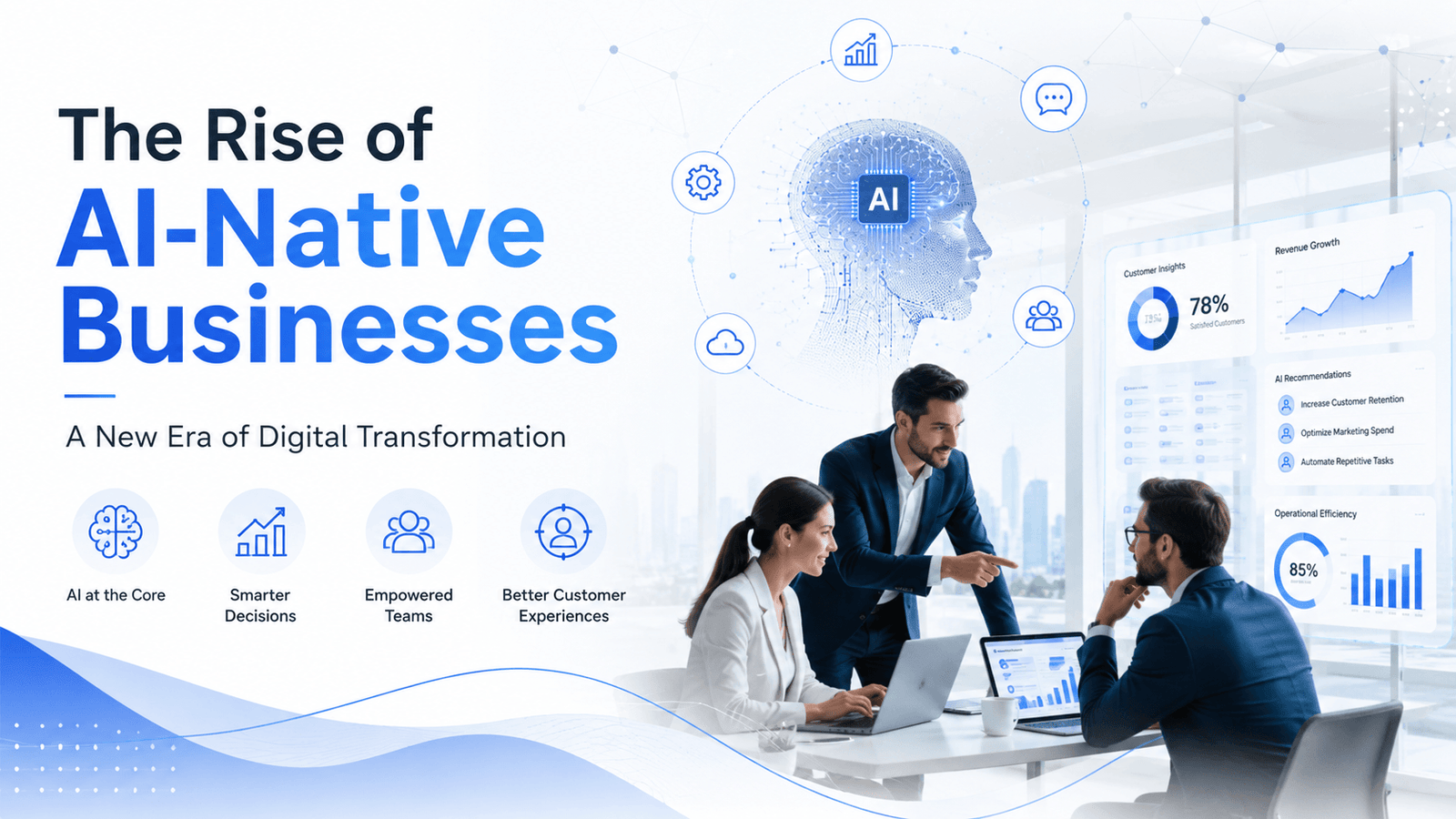
This shift has given rise to what many industry experts describe as AI-native businesses. Unlike traditional organizations that introduce AI as an additional tool, AI-native businesses design their operations, products, and customer experiences with artificial intelligence at their core. Every workflow, decision, and interaction is created with the assumption that AI will play an active role in improving efficiency, supporting employees, and creating better outcomes.
This transformation represents more than another phase of digital transformation. It signals the beginning of a new business era where intelligence becomes embedded into everyday operations rather than existing as a separate capability.
From Digital-First to AI-First
Over the last decade, digital transformation focused primarily on helping businesses move away from paper-based processes and manual workflows. Organizations invested in cloud computing, customer relationship management platforms, enterprise software, mobile applications, and digital collaboration tools. These investments significantly improved efficiency and enabled businesses to operate in an increasingly connected world.
Today, however, the conversation is changing. Simply digitizing processes is no longer enough to remain competitive. Businesses are now asking a different question: how can technology actively support decision-making rather than simply storing information?
Artificial intelligence provides that next step. Instead of waiting for employees to search through reports or manually analyse large amounts of data, AI can identify patterns, generate recommendations, automate repetitive tasks, and provide insights in real time. This allows employees to spend less time gathering information and more time making strategic decisions.
AI-native businesses embrace this mindset from the beginning. Rather than treating AI as an optional feature, they design systems where intelligence is woven into everyday operations, creating faster, smarter, and more adaptive organizations.
AI Becomes Part of Every Business Function
One of the defining characteristics of AI-native businesses is that artificial intelligence is not limited to a single department. Instead, it supports almost every aspect of the organization.
Customer service teams use AI to provide instant assistance while allowing human agents to focus on more complex conversations. Marketing teams analyse customer behaviour to deliver highly personalized campaigns. Sales departments receive intelligent lead scoring and predictive recommendations that help prioritize opportunities. Finance teams automate routine reporting while identifying unusual spending patterns. Human resources use AI to streamline recruitment, onboarding, and workforce planning.
Rather than replacing employees, artificial intelligence enhances their capabilities by removing repetitive administrative work and providing information faster than traditional methods ever could.
This organization-wide adoption creates a connected environment where every department benefits from shared intelligence instead of operating in isolated systems.
Data Becomes a Strategic Asset
Every modern business collects data, but not every business uses it effectively.
Many organizations accumulate information through websites, CRM systems, accounting software, marketing platforms, and customer support channels. Unfortunately, much of this information remains fragmented across different systems, making it difficult to extract meaningful insights.
AI-native businesses approach data differently. They treat it as one of their most valuable strategic assets.
Instead of simply storing information, they continuously analyse customer behaviour, operational performance, market trends, and internal processes to identify opportunities for improvement. AI transforms raw data into actionable insights that help leaders make faster and more informed decisions.
This ability to learn continuously gives AI-native businesses an important competitive advantage. As more data becomes available, their systems become increasingly accurate, enabling smarter recommendations and better business outcomes over time.
Human Expertise Remains Essential
One of the biggest misconceptions surrounding artificial intelligence is that it exists to replace people. In reality, the most successful AI-native businesses understand that technology delivers the greatest value when combined with human expertise.
Artificial intelligence excels at processing large amounts of information, identifying patterns, and completing repetitive tasks with remarkable speed. Humans contribute creativity, emotional intelligence, ethical judgement, strategic thinking, and relationship building—qualities that remain difficult for machines to replicate.
Rather than viewing AI and employees as competitors, AI-native organizations treat them as collaborative partners. Routine work becomes automated, allowing people to focus on innovation, customer relationships, business strategy, and solving complex challenges.
This shift changes the nature of work rather than eliminating it. Employees spend less time performing repetitive activities and more time creating value that requires uniquely human skills.
Customer Expectations Are Changing
As AI becomes more accessible, customer expectations are evolving just as quickly. People now expect businesses to respond faster, deliver personalized experiences, and provide accurate information whenever they need it. Waiting days for a response or navigating complex processes is becoming increasingly unacceptable in a world where intelligent technology can provide immediate assistance.
AI-native businesses are designed to meet these expectations from the very beginning. Their websites, customer portals, and digital platforms often incorporate intelligent assistants capable of answering questions, recommending products or services, scheduling appointments, and guiding users toward the right solution. Behind the scenes, AI continuously analyzes customer interactions to improve future experiences and identify opportunities for better engagement.
Personalization also plays a significant role. Rather than delivering the same experience to every visitor, AI enables businesses to tailor recommendations, content, and communication based on customer preferences and behaviour. This creates stronger relationships, improves customer satisfaction, and increases long-term loyalty.
The businesses that consistently exceed customer expectations will not necessarily be those with the largest teams, but those that use intelligence to create faster, simpler, and more meaningful experiences.
Agility Becomes a Competitive Advantage
Markets evolve rapidly. Customer preferences shift, new competitors emerge, and economic conditions change with little warning. Organizations that rely solely on traditional planning cycles often struggle to respond quickly enough.
AI-native businesses are built with adaptability in mind. By continuously monitoring operational data, customer behaviour, and market trends, they can identify changes earlier and respond more effectively. Instead of relying entirely on historical reports, decision-makers gain access to real-time insights that support faster and more confident decisions.
This level of agility extends across the organization. Marketing campaigns can be adjusted based on customer engagement, inventory forecasts can respond to changing demand, and customer support teams can proactively address common issues before they become larger problems.
The ability to adapt quickly is becoming one of the defining characteristics of successful businesses. Artificial intelligence provides the information needed to make those adjustments with greater speed and accuracy than traditional approaches.
AI Requires Strong Leadership, Not Just Better Technology
Although technology powers AI-native businesses, leadership ultimately determines their success. Implementing artificial intelligence without a clear business strategy often leads to isolated projects that generate limited value.
Successful organizations begin by identifying meaningful business challenges rather than searching for places to apply AI simply because it is available. They focus on improving customer experience, increasing operational efficiency, supporting employees, and creating measurable business outcomes.
Leadership also plays a vital role in building trust. Employees need guidance on how artificial intelligence will support their work, while customers expect transparency regarding how their information is used. Responsible AI governance, ethical decision-making, and continuous learning become essential components of long-term success.
Businesses that invest equally in people, processes, and technology are far more likely to realize the full potential of artificial intelligence than those that focus exclusively on software implementation.
Preparing for an AI-Native Future
Becoming AI-native does not happen overnight. It is a journey that begins with building the right foundation. Organizations should first ensure that their data is accurate, accessible, and connected across the business. Disconnected systems and inconsistent information reduce the effectiveness of AI and limit the quality of the insights it can generate.
The next step involves identifying repetitive tasks, manual workflows, and decision-making processes that could benefit from intelligent automation. Small, well-planned initiatives often create valuable momentum while allowing teams to build confidence in using AI responsibly.
Equally important is investing in people. Employees should be encouraged to develop new skills, understand how AI complements their roles, and embrace a culture of continuous learning. Businesses that prepare their workforce alongside their technology create stronger foundations for sustainable transformation.
The organizations that begin preparing today will be better positioned to take advantage of future innovations as artificial intelligence continues to evolve.
Final Thoughts
The rise of AI-native businesses represents one of the most significant shifts in modern business strategy. While digital transformation introduced organizations to cloud technologies, automation, and connected systems, the next phase is defined by intelligence woven into every aspect of the business.
AI-native organizations are not successful simply because they use artificial intelligence. They succeed because they rethink how work is performed, how decisions are made, and how value is delivered to customers. They combine intelligent technology with human expertise, using automation to remove repetitive tasks while empowering people to focus on creativity, innovation, and strategic thinking.
For business leaders, the question is no longer whether artificial intelligence will influence their industry—it already is. The more important question is how prepared their organization is for a future where AI becomes a fundamental part of everyday business operations.
Businesses that embrace this transformation with a clear strategy, connected systems, high-quality data, and a commitment to continuous learning will be better equipped to adapt, compete, and grow in an increasingly intelligent digital economy. The rise of AI-native businesses is not simply another technology trend; it marks the beginning of a new era of digital transformation that will shape the future of industries worldwide.
Share this article