Building an AI feature can be surprisingly easy.
A developer can connect an application to a language model, send a prompt, receive a response, and have a working prototype within hours. The first version may look impressive, and the initial infrastructure cost may appear almost negligible.
Then the application starts getting real users.
Requests increase. Conversations become longer. Retrieval systems add more context. Agents make multiple model calls. Tools query external services. Failed requests are retried. Background workflows run automatically. More powerful models are introduced to improve quality.
Suddenly, the economics look very different.
This is one of the less discussed challenges of moving AI from experimentation into production. An AI system can work technically and still fail economically.
The question isn't simply how to make AI work.
It is how to make AI work reliably, efficiently, and sustainably at scale.
That is where cost engineering becomes an important part of AI engineering.
The Prototype That Looks Cheap
Early AI prototypes can create a misleading impression about cost.
A developer might test an application with a few dozen requests and conclude that the model is inexpensive enough for production. But those requests rarely represent how users will actually interact with the system.
Production applications have different characteristics.
Users may send longer messages. Conversations may contain significant history. Retrieval systems may attach additional documents. Agents may perform several reasoning steps and tool calls before producing a final answer.
A single user interaction that looked like one model request during development can become a much larger workflow in production.
This means the cost of an AI application cannot be understood simply by looking at the price of one API request.
You have to understand what the application actually does to complete a task.
The Real Unit of AI Cost Is the Task
One of the most useful ways to think about AI economics is to move away from individual model calls.
Consider an AI customer-support agent.
A customer asks:
“Can you check my order and tell me when it will arrive?”
The system might need to:
Understand the request.
Identify the customer.
Retrieve the order.
Call a shipping API.
Retrieve relevant delivery information.
Generate the response.
Validate the result.
From the user's perspective, this is one task.
From the system's perspective, it may involve multiple operations.
The cost of that interaction therefore isn't just the cost of the final response. It includes everything required to complete the task.
This leads to an important principle:
The real unit of AI cost isn't always the model call. It's the business task the system is trying to complete.
Once teams start measuring AI this way, optimization becomes much more meaningful.
The Hidden Cost of Context
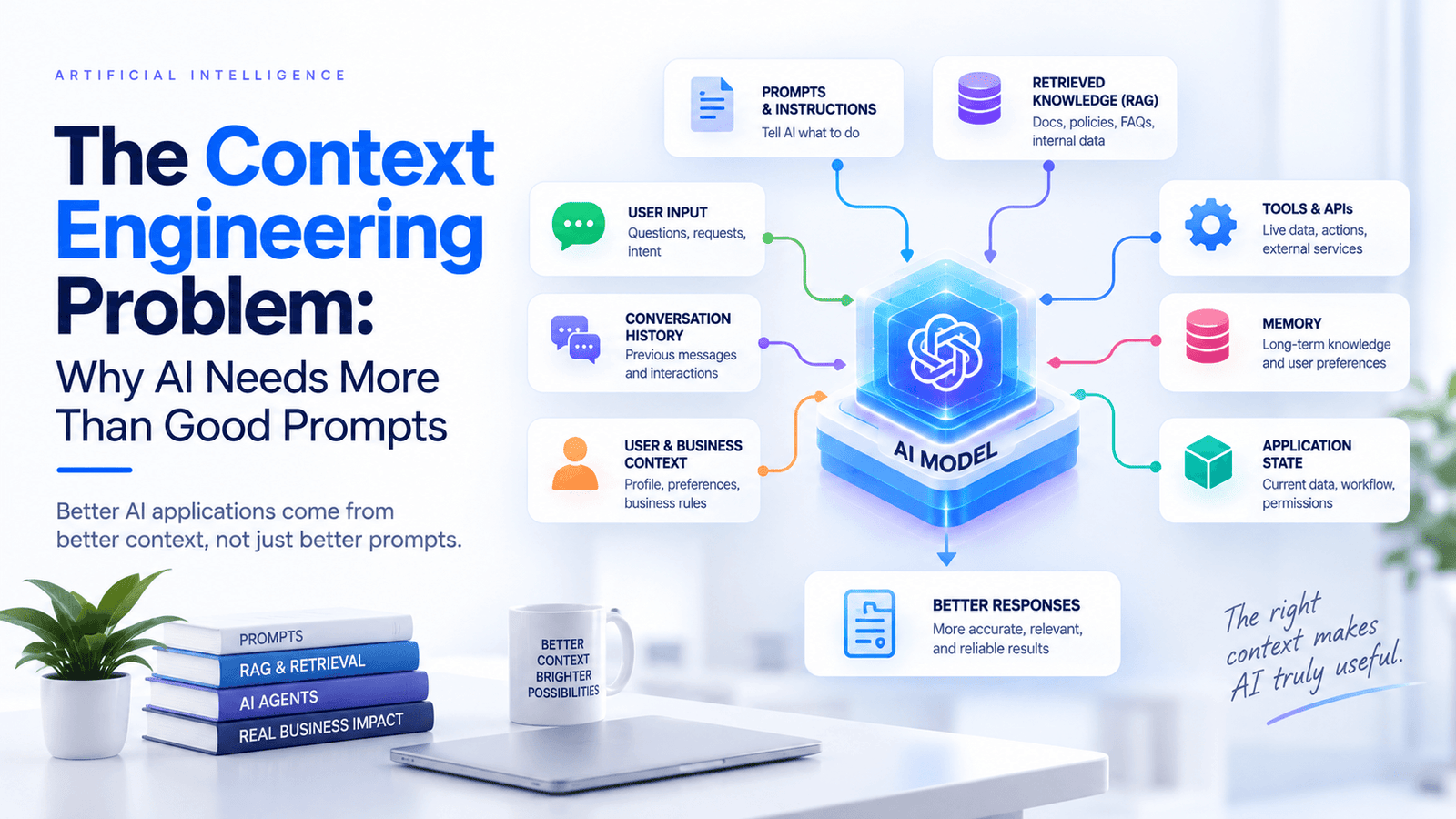
Context is one of the biggest contributors to AI cost.
Modern AI applications may provide models with system instructions, conversation history, retrieved documents, user information, business rules, tool results, and other contextual information.
All of that context has value.
But all of it can also create cost.
A simple question might require only a small amount of information. A complex agentic workflow may accumulate large amounts of context across multiple steps.
Long conversations can become particularly expensive because previous messages may need to be included repeatedly.
Retrieval systems can also increase the amount of information sent to the model.
This creates an important trade-off:
More context can improve quality, but unnecessary context increases cost and latency.
Good context engineering therefore isn't only about improving AI accuracy.
It can also become a cost optimization strategy.
The objective isn't to give the model the maximum amount of information.
It is to give the model the minimum relevant context required to perform the task well.
Agents Can Multiply Model Calls
AI agents introduce another economic challenge.
A traditional AI feature might make one model call and return a response.
An agent can operate differently.
It may reason about a task, select a tool, inspect the result, decide what to do next, retrieve additional information, and eventually produce an answer or perform an action.
That flexibility is powerful.
It can also make costs less predictable.
A simple task may require only a few steps. A difficult task may require significantly more.
If an agent is allowed to continue reasoning without meaningful boundaries, the number of operations can grow unnecessarily.
This is why production agents need architectural constraints.
Developers may need to define maximum steps, control which tools are available, cache reusable results, detect repetitive actions, and determine when a workflow should stop or escalate.
Agent autonomy therefore has an economic dimension as well as a technical one.
The Most Powerful Model Isn't Always the Right Model
Another common approach to AI development is to use the most capable model available for every task.
This can simplify development.
It can also be inefficient.
Not every task requires the same level of intelligence.
A simple classification task may not need the same model used for complex reasoning. A summarization workflow may have different requirements from an autonomous coding agent. A high-volume customer-support request may have very different economics from a low-volume analytical workflow.
This creates an opportunity for model routing.
An application can determine which model is appropriate for a particular task.
For example:
Simple task → Efficient model
Moderately complex task → More capable model
Complex reasoning → Advanced model
This isn't about always choosing the cheapest option.
It is about choosing the model that provides the appropriate cost-to-quality ratio for the task.
The best architecture may therefore use multiple models rather than treating one model as the answer to every problem.
Latency Is Also an Economic Problem
Cost and performance are often discussed separately.
In AI systems, they are closely connected.
A workflow that makes several sequential model calls can become expensive in terms of both money and time.
If an agent has to perform five operations sequentially before returning an answer, every additional step can contribute to latency.
That matters for user-facing applications.
A slow AI feature can reduce engagement, increase abandonment, and create a poor customer experience even if the underlying responses are high quality.
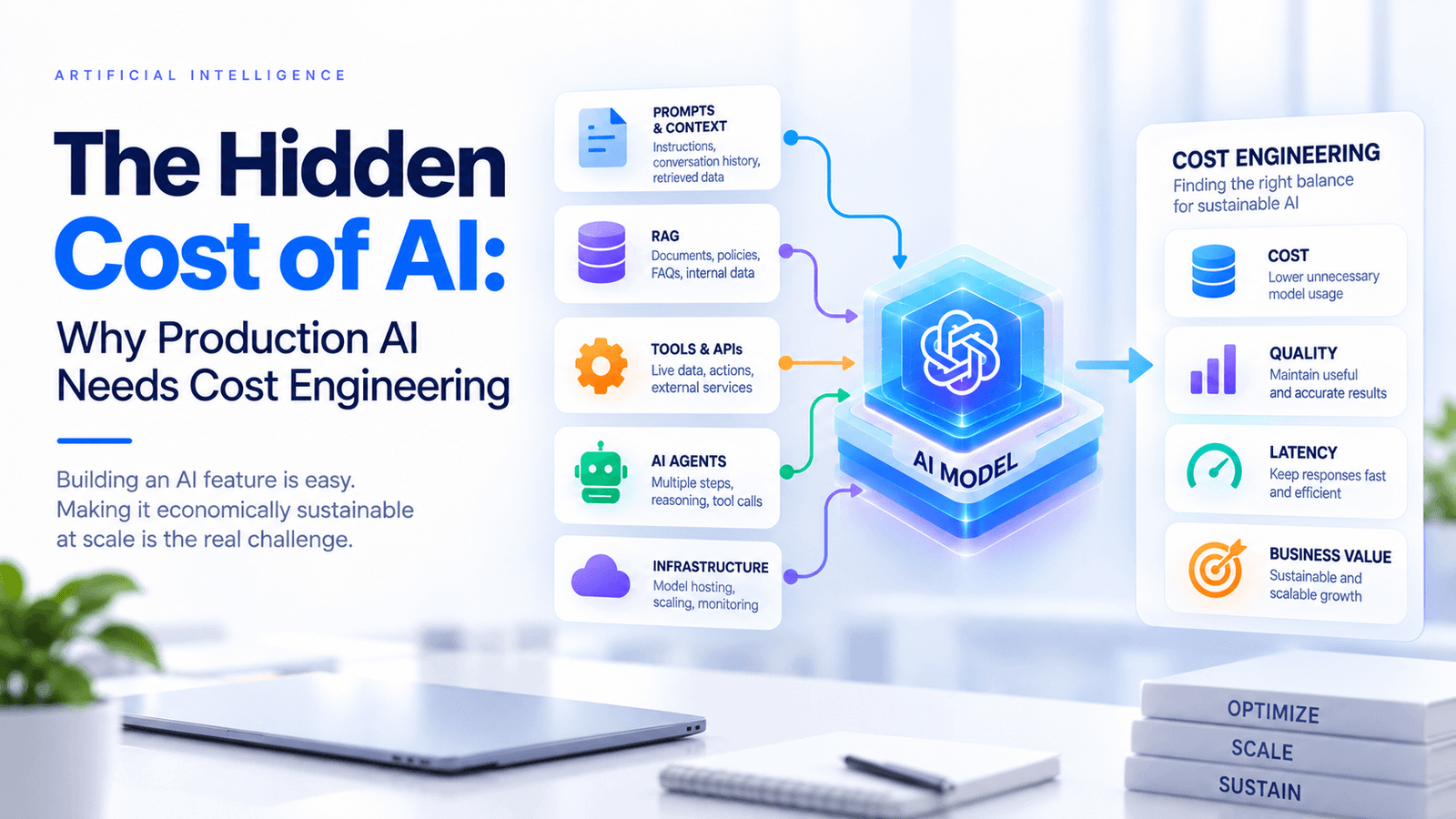
Businesses therefore need to consider at least three dimensions:
Quality
Cost
Latency
Optimizing one without considering the others can create a different problem.
Reducing model usage aggressively may lower cost but damage quality. Using larger models everywhere may improve quality but increase both cost and latency.
The goal is not to optimize one number.
It is to find the right balance for the business task.
Caching Can Eliminate Unnecessary Work
AI applications sometimes repeat the same work unnecessarily.
A system might repeatedly retrieve identical information or generate similar responses to common requests.
Caching can reduce that repeated work.
For example, frequently requested information can sometimes be cached rather than regenerated. Retrieval results may be reusable for a period of time. Certain deterministic operations can be handled without calling a model at all.
This leads to a broader architectural principle:
The cheapest AI operation is often the one you don't need to perform.
Not every part of an AI workflow needs to involve a language model.
Traditional software can still handle deterministic operations extremely well.
If a calculation can be performed reliably with normal code, there may be little reason to ask a model to perform it.
If a database can answer a question directly, the application may not need to send the request through an LLM first.
Good AI architecture therefore isn't about maximizing the amount of AI in a system.
It is about using AI where it provides meaningful value.
Traditional Software Still Has a Role
The rise of AI doesn't eliminate conventional software engineering.
In fact, cost-conscious AI systems often depend heavily on it.
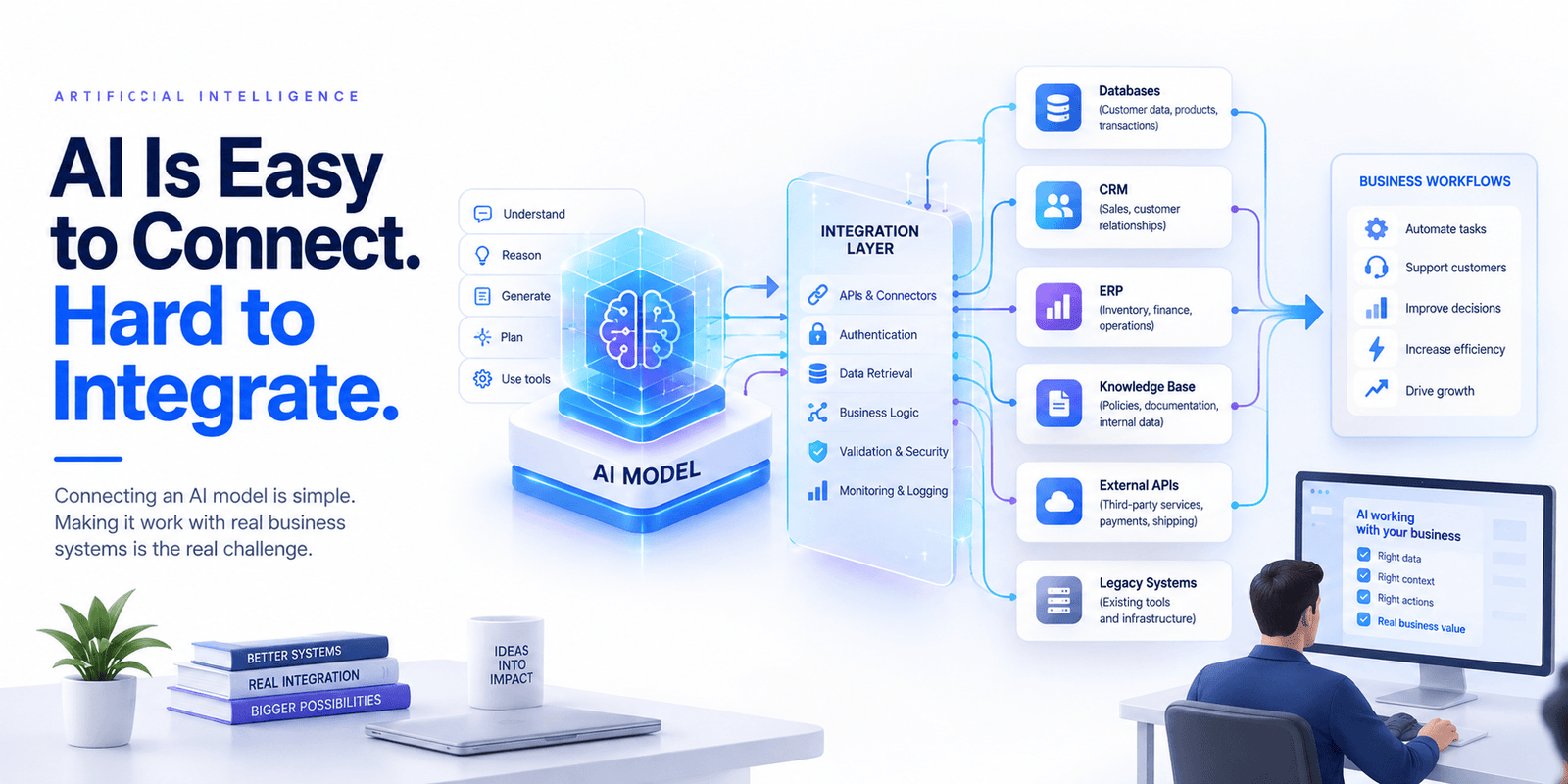
Business rules, calculations, authentication, permissions, validation, data processing, caching, routing, and deterministic workflows can often be handled more efficiently outside the model.
The model can focus on areas where language understanding, reasoning, classification, or generation provides real value.
This creates a hybrid architecture:
Traditional software handles deterministic work.
AI handles probabilistic work where intelligence adds value.
The boundary between these two should be intentional.
If a developer sends every operation through an LLM simply because an AI model is available, the system can become more expensive, slower, and harder to control than necessary.
Retries Have a Cost
Failures are inevitable in distributed systems.
AI applications can experience model errors, timeouts, tool failures, network problems, invalid responses, and temporary service issues.
Retry mechanisms are therefore important.
But retries can also multiply costs.
A poorly designed workflow might repeatedly send the same expensive request without understanding why the previous attempt failed.
Production systems need intelligent retry strategies.
Some failures should be retried.
Some should be handled differently.
Some should immediately stop the workflow.
And some should be escalated to a human.
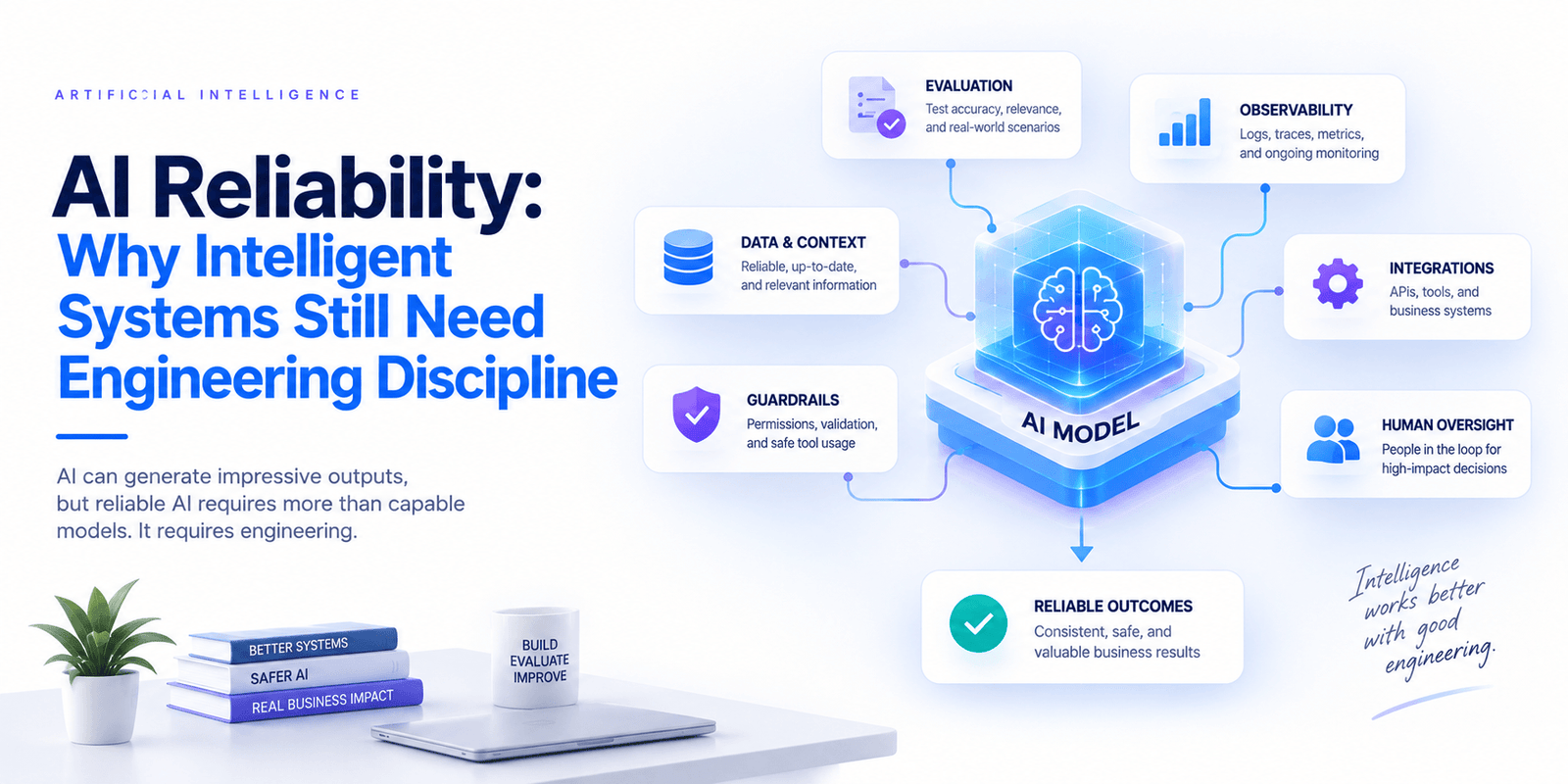
Reliability engineering and cost engineering therefore overlap.
A system that repeatedly performs unnecessary work isn't just inefficient.
It is also unnecessarily expensive.
Cost Per Token Isn't Enough
AI providers typically expose usage metrics that make it possible to track model consumption.
Those metrics are useful, but they don't necessarily tell the complete business story.
Suppose one AI workflow consumes more tokens than another.
That doesn't automatically mean it is more expensive in business terms.
The first workflow might resolve a customer issue completely without human intervention.
The second might use fewer tokens but frequently require a support employee to finish the task.
The actual business economics can therefore depend on more than model usage.
Organizations may want to measure metrics such as:
Cost per completed task
Cost per successful resolution
Cost per customer interaction
Cost per automated workflow
Human escalation rate
Average latency
Failure rate
Revenue or operational value generated
This changes the question from:
“How many tokens are we using?”
to:
“How much does it cost us to produce a successful outcome?”
That is a much more useful business metric.
AI Needs FinOps Thinking
Cloud infrastructure introduced the idea that engineering teams need visibility into infrastructure spending.
AI is creating a similar need around model usage.
Teams need to understand where AI resources are being consumed and which workflows are responsible for the cost.
For larger AI applications, this can involve tracking usage by:
Product
Feature
Customer
Workflow
Model
Environment
Agent
Business function
Without this visibility, cost problems can remain hidden.
A feature may appear successful because users like it while quietly generating costs that make the business model difficult to sustain.
Cost observability therefore becomes increasingly important as AI usage grows.
Optimize Architecture Before Optimizing Prompts
AI cost optimization can sometimes become overly focused on prompt wording.
Shorter prompts can help.
But architecture usually has a much larger influence.
Consider the difference between:
One well-designed workflow with efficient retrieval and appropriate model selection
and
A workflow that repeatedly retrieves information, sends large contexts, calls several models, invokes unnecessary tools, and retries failed operations.
The second system cannot be rescued simply by shortening a few sentences in its prompt.
Cost engineering needs to happen at the architectural level.
That means asking:
Do we need this model call?
Do we need this much context?
Does this task require this model?
Can this result be cached?
Can deterministic logic handle this operation?
Can multiple operations happen in parallel?
Can the workflow stop earlier?
These questions can have a much greater impact than prompt-level optimization alone.
AI Systems Need Cost Budgets
Traditional applications often have resource constraints.
AI applications can benefit from similar boundaries.
A workflow might have a maximum number of model calls.
An agent might have a maximum number of tool invocations.
A customer interaction might have a target cost range.
A background workflow might have a maximum processing budget.
These constraints don't necessarily make the system worse.
They can make the architecture more intentional.
When an AI workflow reaches its limits, it can choose another path:
Simplify → Retry → Escalate → Ask for clarification → Stop
This prevents uncontrolled AI usage from becoming an invisible operational cost.
Cost Engineering Is Not About Making AI Cheap
There is an important distinction between cost reduction and cost engineering.
The goal isn't simply to minimize AI spending.
If reducing costs makes the product significantly less useful, the optimization has failed.
A customer-support agent that saves money but gives poor answers isn't creating sustainable value.
Likewise, an AI coding system that uses an inexpensive model but takes significantly longer to complete useful work may not actually be more efficient.
Cost engineering is about finding the right relationship between:
Cost + Quality + Latency + Reliability + Business Value
Sometimes spending more on AI is completely justified if it produces significantly better outcomes.
The important thing is that the decision is intentional and measurable.
The Economics Should Influence the Architecture
AI cost shouldn't be something engineers discover after the system is built.
It should influence architecture from the beginning.
When designing an AI feature, teams should think about:
Expected usage
Average task complexity
Context size
Number of model calls
Tool usage
Retrieval requirements
Model selection
Caching opportunities
Failure and retry behavior
Latency requirements
Human escalation
Expected business value
This makes economics part of system design rather than a problem that appears after deployment.
The best AI architecture is not necessarily the one that uses the most sophisticated components.
It is the one that produces the required outcome with an appropriate combination of intelligence, reliability, speed, and cost.
From AI Prototype to Sustainable Product
The transition from prototype to production changes the questions engineers need to ask.
During experimentation:
Can we make the model do this?
During production:
Can we make it do this reliably?
At scale:
Can we make it do this reliably and economically?
That final question is increasingly important.
AI will become part of customer support, software development, operations, research, commerce, analytics, and many other business processes.
As adoption grows, the cost of every unnecessary model call, oversized context, redundant retrieval, and inefficient workflow becomes more significant.
This doesn't mean businesses should avoid using AI.
It means they need to engineer it properly.
Conclusion
AI has made it easier than ever to build impressive prototypes.
But production AI is not just a model connected to an application.
It is a system with models, data, context, retrieval, tools, workflows, infrastructure, users, and business objectives.
Every one of those components can influence the economics of the final product.
The organizations that succeed with AI will not necessarily be the ones that use the most powerful models everywhere.
They will be the ones that understand where intelligence creates value, where traditional software is more efficient, where context can be reduced, where work can be reused, and where additional model capability is actually worth the cost.
AI cost engineering isn't about making AI cheap. It's about making AI economically sustainable.
And as AI moves deeper into production, that may become just as important as making it intelligent.
Share this article