Artificial intelligence is no longer limited to generating content, answering questions, or assisting with basic tasks. A new generation of intelligent systems is changing how businesses operate by taking on meaningful work across departments. These systems, known as AI agents, are becoming an extension of the modern workforce, helping organizations streamline operations, improve decision-making, and deliver better customer experiences.
This shift represents one of the biggest advancements in business technology since the rise of cloud computing and automation. Instead of simply using AI as another software tool, organizations are beginning to treat AI agents as digital team members capable of completing tasks, collaborating with employees, and supporting business operations around the clock.
For business leaders, the question is no longer whether artificial intelligence will play a role in their organization. The real question is how AI agents can become part of their workforce and create lasting competitive advantages.
Beyond Chatbots: Understanding AI Agents
Many people still associate artificial intelligence with chatbots that answer customer questions or generate text. While chatbots remain valuable, AI agents represent a much more advanced evolution of AI.
Unlike traditional chatbots that simply respond to prompts, AI agents are designed to accomplish goals. They can understand business objectives, gather information from multiple sources, make informed decisions, perform actions across different software platforms, and continue working until a task is completed. They don't just provide answers—they actively contribute to business processes.
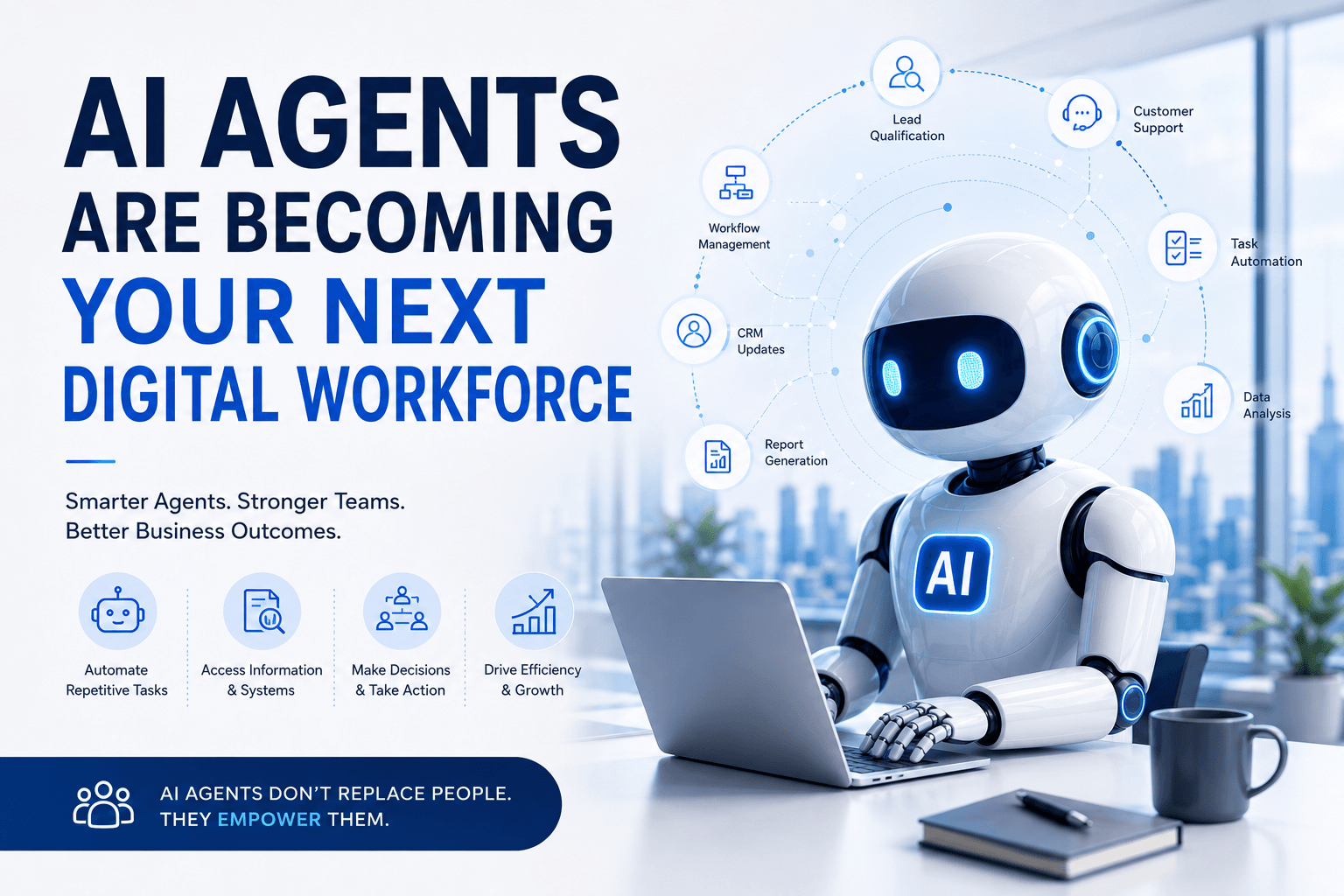
Imagine a new customer inquiry arriving through your company's website. Instead of forwarding the request to a sales representative, an AI agent could research the prospect, qualify the lead, update the CRM, schedule a meeting, prepare background information, and even draft a personalized follow-up email. Tasks that once required multiple employees and several different applications can now be coordinated through a single intelligent system.
This ability to reason, act, and integrate with business systems is what distinguishes AI agents from traditional AI applications.
Why Businesses Are Embracing AI Agents
Every modern organization faces the same challenge: employees spend too much time performing repetitive administrative work instead of focusing on activities that create real business value. Updating spreadsheets, searching for documents, copying information between systems, responding to routine emails, and generating reports consume valuable hours every day.
AI agents help eliminate much of this repetitive work. They automate digital tasks while allowing employees to concentrate on strategy, innovation, relationship building, and solving complex problems that require human judgment.
The benefits extend across every department. Customer service teams can respond faster and more accurately. Sales professionals spend more time closing deals instead of managing administrative work. Marketing teams receive faster insights from campaign data. Finance departments reduce manual reporting, while operations teams gain better visibility into business performance.
Rather than replacing employees, AI agents enable people to spend more time doing the work that truly matters.
What Can AI Agents Actually Do?
The capabilities of AI agents continue to expand as organizations integrate them into their daily operations. Their greatest strength lies in their ability to manage complete workflows rather than isolated tasks.
In customer service, AI agents can answer complex questions, retrieve information from internal knowledge bases, resolve common support requests, and escalate unique situations to human representatives when necessary. This allows support teams to handle larger volumes of inquiries while maintaining high service quality.
Within sales, AI agents can qualify incoming leads, gather company information, prepare meeting summaries, recommend follow-up actions, update CRM records, and generate personalized outreach messages. Sales teams spend less time on administrative work and more time building customer relationships.
Marketing departments can use AI agents to analyze campaign performance, identify customer trends, create reports, recommend content strategies, and monitor audience engagement across multiple channels.
Operations teams benefit from AI agents that monitor workflows, identify bottlenecks, coordinate approvals, manage inventory alerts, and ensure business processes continue running smoothly.
Human resources teams can automate employee onboarding, answer internal policy questions, organize documentation, schedule interviews, and assist with internal communication. Across every department, AI agents reduce repetitive work while improving operational efficiency.
AI Agents Become Powerful Through Connected Systems
The real power of AI agents does not come from artificial intelligence alone. It comes from their ability to connect with the systems businesses already rely on every day.
Most organizations operate using dozens of different platforms, including customer relationship management software, accounting systems, project management tools, communication platforms, cloud storage, websites, and internal databases. Unfortunately, these systems often operate independently, forcing employees to manually move information from one application to another.
AI agents remove these barriers by connecting multiple systems into a unified workflow. They can retrieve customer information from a CRM, verify inventory levels, update project management software, schedule meetings, send emails, generate reports, and trigger automated workflows without requiring constant human intervention.
When data flows seamlessly between systems, organizations become faster, more accurate, and more responsive. This level of integration transforms AI agents from simple assistants into valuable digital employees capable of supporting entire business processes.
Human Expertise Will Always Matter
The growing adoption of AI agents has raised understandable questions about the future of work. However, successful organizations recognize that artificial intelligence is designed to complement human expertise rather than replace it.
AI agents excel at processing large amounts of information, identifying patterns, completing repetitive tasks, and following structured workflows. Humans, on the other hand, bring creativity, strategic thinking, emotional intelligence, leadership, and relationship-building skills that technology cannot replicate.
The most successful businesses will combine these strengths. AI agents will handle routine digital work, while employees focus on innovation, customer relationships, critical decision-making, and business growth.
Instead of competing with people, AI agents become trusted digital teammates that increase productivity while allowing employees to contribute where they create the greatest value.
Challenges Businesses Must Prepare For
Implementing AI agents successfully requires more than simply adopting new technology. Organizations must first ensure that their data is accurate, organized, and accessible. Artificial intelligence is only as effective as the information it receives.
Security and privacy are equally important. AI agents often interact with sensitive customer information, financial records, and internal business data. Proper governance, access controls, and human oversight remain essential to ensure responsible and secure AI adoption.
Businesses should also establish clear objectives before implementing AI agents. Rather than introducing AI simply because it is popular, organizations should identify specific business challenges that intelligent automation can solve. Measuring outcomes, continuously improving workflows, and maintaining human supervision help ensure long-term success.
Preparing for an AI-Powered Workforce
Organizations do not need to transform overnight to benefit from AI agents. The most effective approach is to begin with repetitive, high-volume processes that consume significant employee time.
Businesses should first identify manual workflows, improve data quality, connect existing systems, and establish governance policies before gradually expanding AI capabilities across departments. This step-by-step approach minimizes disruption while allowing employees to adapt to new ways of working.
Employee education is equally important. Teams need to understand how AI agents support their work, what responsibilities remain human-led, and how collaboration between people and AI creates stronger business outcomes.
Companies that invest in both technology and their workforce will be best positioned to maximize the benefits of AI-driven transformation.
Final Thoughts
AI agents are quickly becoming one of the most significant innovations in modern business. They represent a shift from using artificial intelligence as a productivity tool to building intelligent digital workforces capable of performing meaningful business operations.
The organizations that achieve the greatest success will not necessarily be those that purchase the most AI software. Instead, they will be the ones that integrate AI agents into their existing systems, empower employees to work alongside them, and redesign business processes around intelligent collaboration.
The future of work is not about replacing people with artificial intelligence. It is about creating organizations where human expertise and AI agents work together to deliver faster decisions, better customer experiences, improved operational efficiency, and sustainable business growth.
Businesses that begin building this collaborative digital workforce today will be far better prepared for the opportunities and challenges of tomorrow's intelligent economy.
Share this article