For a long time, much of the conversation around building AI applications focused on prompt engineering.
Write a better instruction. Give the model a clearer role. Add examples. Refine the wording. Experiment with different prompts.
These techniques are still useful. A well-designed prompt can significantly influence how an AI system behaves.
But as AI applications become more sophisticated, especially applications using RAG, tools, memory, and agents, the prompt is becoming only one part of a much larger problem.
The bigger question is not simply:
“What should we tell the model?”
It is:
“What information should the model have when it needs to make a decision?”
That is the context engineering problem.
Prompt Engineering Was Never the Whole Picture
A prompt provides instructions to a model, but a production AI application rarely depends on instructions alone.
Consider an AI customer-support assistant.
The user's message might be:
“Where is my order?”
The prompt can tell the model to behave as a helpful customer-support assistant. But that instruction doesn't tell it which order the customer placed, whether the order has shipped, where it currently is, or what the company's delivery policy says.
The system needs to gather that information.
It may need to retrieve the customer's account, query an order-management API, retrieve the relevant shipping policy, and include the results in the model's context.
The quality of the final response therefore depends not only on the prompt.
It depends on what the model was given to work with.
What Is Context Engineering?
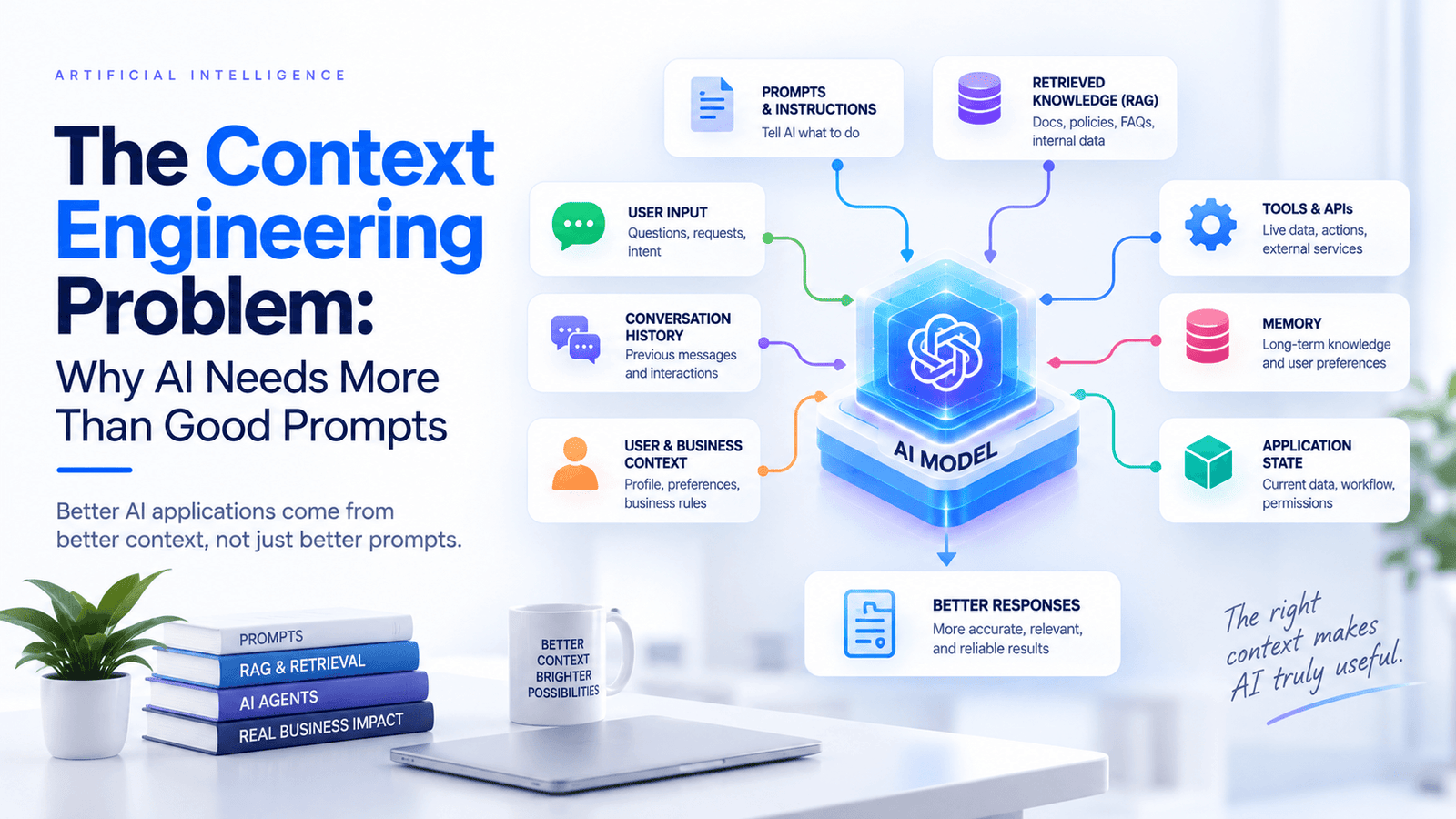
Context engineering is the process of designing how relevant information is selected, structured, and delivered to an AI model for a particular task.
The context available to a model can include much more than a prompt.
It can include:
System instructions
User input
Conversation history
Retrieved documents
Database information
User preferences
Long-term memory
Tool results
Business rules
Current application state
Previous actions
External API responses
A useful way to think about a modern AI application is:
User Input + Instructions + Relevant Context + Tools + Memory → Model → Action or Response
The model is responsible for generating or reasoning over the information it receives.
The application is responsible for deciding what information should reach the model in the first place.
That distinction is becoming increasingly important.
Context Is Dynamic
One of the biggest differences between traditional prompting and context engineering is that context doesn't always have to be static.
Imagine an AI shopping assistant.
A customer asks:
“Do you have this in blue?”
The system may need to understand which product the customer is referring to, retrieve the product information, check current inventory, identify available variations, and then provide the model with the relevant results.
The context is being assembled dynamically based on the conversation and the task.
Another request may require completely different information.
This means production AI systems increasingly need a context pipeline rather than a single large prompt.
The system decides what the model needs for this particular interaction.
RAG Is Part of Context Engineering
Retrieval-augmented generation, or RAG, is one of the most common examples of context engineering.
Instead of expecting a model to know everything, an application retrieves relevant information from an external knowledge source and provides it to the model.
For example, a company may have thousands of documents containing:
Product information
Internal policies
Technical documentation
FAQs
Support procedures
Company guidelines
When a user asks a question, the system searches for relevant information and provides selected results as context.
The model then generates an answer based on that information.
But RAG itself isn't the entire solution.
The quality of the final answer depends heavily on the quality of the retrieval process.
If the wrong documents are retrieved, the model receives the wrong context.
And even a highly capable model cannot reliably compensate for irrelevant information.
Retrieval Quality Becomes Context Quality
This creates an important relationship:
Poor retrieval → Poor context → Poor output
A system may have an excellent vector database and a powerful model, but if the retrieval pipeline consistently returns irrelevant or incomplete information, the overall application can still perform poorly.
This is why chunking, metadata, filtering, ranking, query transformation, and retrieval strategies matter.
Imagine a technical document containing a hundred pages of information.
Breaking it into meaningful chunks can make relevant sections easier to retrieve.
But chunking too aggressively can remove important relationships between pieces of information.
Chunking too broadly can return large amounts of irrelevant material.
Context engineering therefore starts much earlier than the final model call.
It begins with how information is organized, indexed, retrieved, and selected.
More Context Is Not Always Better
It can be tempting to assume that giving a model more information will make it more intelligent.
In practice, more context can introduce its own problems.
Large amounts of irrelevant information can make it harder for the model to identify what matters. It can increase token consumption and latency while potentially introducing conflicting or outdated information.
Consider a customer asking about a refund.
The system might have access to thousands of internal documents.
Providing all of them would not necessarily help.
The useful context may only be:
The customer's order
The applicable refund policy
The product involved
The relevant transaction information
Good context engineering therefore isn't about maximizing the amount of information sent to the model.
It is about maximizing the relevance of the information.
The Context Window Isn't the Same as Useful Context
Modern models can process increasingly large amounts of information.
But a large context window doesn't remove the need for context engineering.
A model being capable of receiving a large amount of information doesn't mean every piece of that information is useful.
The application still needs to decide:
What belongs in the context?
What should be excluded?
What should have higher priority?
What information is current?
What information is authoritative?
What information conflicts with something else?
These questions become increasingly important as applications become more complex.
A large context window gives an application more capacity.
It doesn't automatically give the application better context.
Memory Adds Another Layer
Memory introduces another important dimension to context engineering.
An AI assistant may need to remember information from previous interactions.
For example, a user might have previously said that they prefer a particular communication style or frequently work with a specific type of product.
A future interaction may benefit from that information.
But memory needs to be carefully managed.
Not every conversation detail should become permanent memory.
Some information may become outdated. Some may only be relevant temporarily. Some may be irrelevant to future tasks.
This means an AI system needs to decide what information should be retained and when it should be retrieved.
Memory is therefore not simply a storage problem.
It is a context selection problem.
The system needs to determine what past information is relevant to the current task.
Tools Can Change Context in Real Time
Tools make context even more dynamic.
An AI agent may start with a user's request and then decide that it needs additional information.
It might call:
Search → Database → API → Calculator → External Service
Each tool can return new information.
That information can then become part of the model's next context.
For example:
User: “Can I return my order?”
The system may:
Identify the order.
Retrieve the order details.
Check the current return policy.
Calculate whether the order is still within the return window.
Provide those results to the model.
Generate the appropriate response.
The model isn't simply answering from its original context.
The context is evolving throughout the workflow.
This is one reason agentic systems require more sophisticated context management than simple chat applications.
Business Context Matters
AI systems also need to understand the environment in which they operate.
A general-purpose model may understand what a refund is.
But a business has its own refund rules.
A company may allow returns within 30 days for some products and 14 days for others. Some items may be non-refundable. Certain customers may have specific account restrictions.
These rules should not simply be assumed by the model.
The system needs to provide the relevant business context and, where necessary, enforce deterministic rules outside the model.
This creates an important distinction between knowledge and authority.
The model may understand a concept.
The business system should remain the authoritative source for current business data and rules.
Context Needs to Be Fresh
Relevance isn't the only requirement.
Context also needs to be current.
Imagine an AI shopping assistant recommending a product based on inventory information from yesterday.
The answer might be perfectly reasonable based on the information provided to the model.
But if the product sold out this morning, the response is still wrong for the customer.
This is why AI systems often need a combination of static knowledge and live data.
Documents and knowledge bases can provide background information.
APIs and databases can provide current operational information.
The system needs to understand which source should be used for which type of information.
A useful principle is:
Use authoritative sources for information that changes.
Context Should Be Grounded
Another important property of good context is grounding.
When an AI system is expected to answer using company information, the relevant information should ideally come from identifiable and trusted sources.
This can make the system easier to validate and debug.
For example, instead of simply asking an AI model:
“What is our refund policy?”
the application can retrieve the current refund-policy document and provide it as context.
The model then has a concrete source from which to construct the response.
Grounding doesn't eliminate every possible error, but it creates a stronger relationship between the generated response and the information the system actually retrieved.
Context Engineering for AI Agents
Context engineering becomes even more important when working with AI agents.
An agent may have:
A goal
Previous conversation
Memory
Available tools
Tool results
Retrieved knowledge
Current application state
Intermediate results
Business rules
Permissions
If all of this information is placed into the context indiscriminately, the system can become inefficient and difficult to manage.
Instead, the agent needs to receive the information relevant to its current step.
For example, an agent researching a customer issue may initially need customer and account information.
After calling an order API, it may need the returned order data.
When preparing a resolution, it may need the relevant company policy.
Context therefore changes as the agent progresses through the workflow.
This makes context management a fundamental part of agent architecture.
Context Should Have Priorities
Not all information has equal importance.
An AI system may receive instructions from several sources.
There may be system-level rules, application instructions, business policies, retrieved information, user input, and tool results.
These sources can sometimes conflict.
A production system needs a clear hierarchy for how different types of information should be treated.
For example, security and system-level restrictions should not simply be overridden because a user asks the model to ignore them.
Similarly, an outdated document shouldn't necessarily override current information from an authoritative business system.
Context engineering therefore involves not just collecting information, but structuring and prioritizing it.
Evaluating Context Quality
AI evaluation often focuses on the final answer.
But if the answer is wrong, the underlying problem may have occurred much earlier.
Perhaps the retrieval system returned the wrong document.
Perhaps the relevant document was available but ranked too low.
Perhaps the database contained outdated information.
Perhaps the tool returned incomplete data.
Perhaps the correct information was retrieved but wasn't included in the final context.
This means AI systems can benefit from evaluating the context pipeline itself.
Teams can ask:
Did we retrieve the right information?
Was the information relevant?
Was it complete?
Was it current?
Was the authoritative source selected?
Did the model actually receive the information it needed?
This creates a more useful debugging model:
User Request → Retrieval → Context → Model → Output
Instead of evaluating only the final output, teams can evaluate the entire chain.
Context Engineering Is Becoming a Core AI Skill
As AI applications become more sophisticated, the engineering challenge is shifting.
Early AI applications often focused heavily on prompt design.
Modern AI systems increasingly require developers to understand retrieval, data architecture, vector search, memory, APIs, tools, business systems, permissions, evaluation, and orchestration.
This doesn't make prompt engineering irrelevant.
It puts it into a larger system.
A well-written prompt can tell the model how to behave.
A well-designed context pipeline determines what the model has available when it behaves.
Both matter.
But as applications become more complex, the second problem becomes increasingly difficult.
Building a Context Pipeline
A production AI application might have a pipeline that looks something like:
User Request
↓
Intent Detection
↓
Context Selection
↓
Retrieval + Memory + Business Data
↓
Tool Calls Where Required
↓
Context Filtering and Prioritization
↓
Model
↓
Validation / Evaluation
↓
Response or Action
This architecture separates the model from the responsibility of gathering all the information it needs.
The application orchestrates the process.
The model operates on the context provided to it.
This separation can make AI systems easier to control, evaluate, and improve.
The Future Is Context-Aware AI
AI models will continue to become more capable.
They will reason better, follow instructions more effectively, use tools more naturally, and process increasingly large amounts of information.
But better models don't eliminate the need for good context.
If anything, the more capable AI becomes, the more valuable high-quality context becomes.
An intelligent system that receives irrelevant information is still limited by that information.
An intelligent system that receives accurate, relevant, current, and well-structured information has a much stronger foundation for useful behavior.
The future of AI engineering therefore isn't only about building smarter models.
It is also about building smarter pipelines for delivering information to those models.
Final Thoughts
Prompt engineering asks:
“How should we instruct the model?”
Context engineering asks a much broader question:
“What does the model need to know right now to perform this task effectively?”
That information might come from a document, a vector database, a traditional database, an API, a tool, a previous conversation, a memory system, or a live business application.
The challenge is selecting the right pieces, keeping them relevant, maintaining their freshness, respecting their authority, and presenting them in a form the model can use.
That is why context engineering is becoming such an important part of modern AI architecture.
The future isn't simply about models with larger context windows.
It's about systems that understand which context matters.
Prompt engineering tells AI what to do. Context engineering determines what AI has available to do it.
Share this article