For many years, businesses treated websites as digital brochures. Their purpose was simple: display information, showcase services, and provide contact details. Once launched, they often remained unchanged for months or even years.
That approach no longer meets modern expectations.
Today's users expect websites to behave like the applications they use every day. Whether they're ordering food, managing finances, booking appointments, collaborating with colleagues, or shopping online, people have become accustomed to fast, interactive, and highly responsive digital experiences. They carry those expectations with them whenever they visit a business website.
As a result, the line between a traditional website and a web application has become increasingly blurred.
This shift isn't simply about adopting newer technologies. It reflects a broader change in how businesses deliver value online. The modern web stack exists because organisations need digital platforms that are fast, scalable, secure, and capable of supporting increasingly complex customer interactions.
Websites Have Evolved Beyond Static Pages
The early web was designed primarily for publishing information. Websites consisted of static HTML pages that rarely changed after deployment. Every update required manual editing, making content management both slow and expensive.
Content Management Systems such as WordPress transformed website development by allowing businesses to manage content without technical expertise. This innovation made publishing easier, but the primary purpose of websites remained largely informational.
Today, however, businesses rely on their websites to perform far more sophisticated functions.
Customers expect to search products instantly, schedule appointments, complete purchases, access secure portals, monitor order status, submit documents, communicate with support teams, and receive personalised recommendations—all without leaving the website.
In many cases, what appears to be a website is actually a business application operating through a web browser.
User Expectations Are Driving the Evolution
Technology alone isn't responsible for this transformation. Customer expectations have changed dramatically.
People interact daily with platforms like online banking, streaming services, project management software, and cloud-based productivity tools. These experiences have established a new standard for speed, responsiveness, and convenience.
When users visit a business website today, they naturally expect:
Instant page loading
Real-time search results
Personalised experiences
Interactive dashboards
Secure client portals
Online bookings
Seamless checkout experiences
AI-powered assistance
Mobile-first interactions
A website that simply presents information increasingly feels outdated.
Modern users expect digital experiences that respond to their actions rather than static pages that require constant navigation.
Understanding the Modern Web Stack
The phrase modern web stack refers to the collection of technologies, architectural principles, and development practices used to build today's interactive digital experiences.
Rather than relying on a single platform or framework, modern applications combine specialised technologies that each solve different challenges.
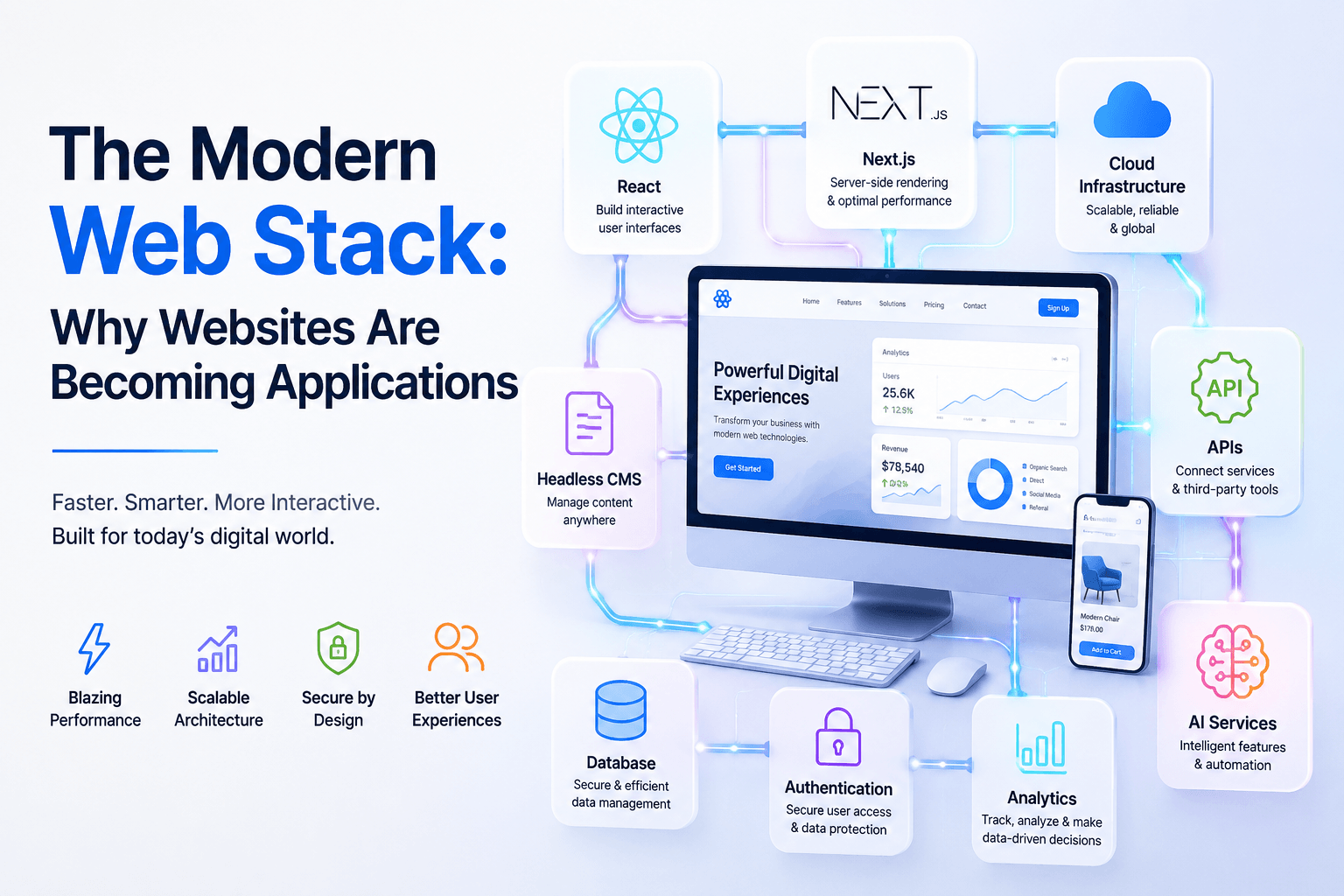
A typical modern web stack may include:
React for building dynamic user interfaces
Next.js for server-side rendering, routing, and performance optimisation
Headless CMS platforms for flexible content management
REST or GraphQL APIs for connecting systems and services
Cloud infrastructure for scalability and reliability
Authentication services for secure user access
AI services that provide intelligent features and automation
Importantly, these technologies are not goals in themselves.
Businesses rarely benefit from using React instead of another framework simply because it is popular. The real value lies in the experiences these technologies make possible.
Performance Is No Longer Optional
Website performance has become a business metric rather than simply a technical concern.
Research consistently shows that slower websites lead to higher bounce rates, reduced engagement, lower conversion rates, and decreased customer satisfaction.
Modern web architectures prioritise performance from the very beginning.
Instead of loading every resource at once, applications deliver only what users need. Images are optimised automatically, JavaScript is split into smaller bundles, pages are rendered efficiently, and content is distributed through global delivery networks.
These improvements may appear technical, but their impact is entirely business-focused.
A faster website creates a better first impression, improves search visibility, increases customer confidence, and encourages users to complete meaningful actions.
APIs Are Connecting the Entire Business
One of the defining characteristics of the modern web stack is its ability to integrate multiple systems into a single experience.
A customer visiting a website may unknowingly interact with numerous services simultaneously.
Product information might come from an inventory system.
Payments are processed through secure payment providers.
Appointments synchronise with scheduling software.
Marketing platforms personalise content.
Customer information updates a CRM automatically.
AI services answer questions in real time.
Rather than operating independently, these systems communicate through APIs to create a seamless experience for both customers and employees.
The website becomes the central interface through which an entire digital ecosystem operates.
Content Management Is Becoming More Flexible
Traditional Content Management Systems tightly coupled content with presentation. While this approach worked well for many years, businesses now publish content across websites, mobile applications, digital displays, customer portals, and AI-powered interfaces.
This demand has accelerated the adoption of headless architecture.
A headless CMS separates content management from the frontend experience. Content is created once and delivered wherever it is needed through APIs.
This flexibility allows businesses to adapt more quickly as new digital channels emerge without rebuilding their entire content infrastructure.
AI Is Expanding What Websites Can Do
Artificial intelligence is introducing another significant evolution.
Rather than serving purely informational content, websites are increasingly capable of understanding user behaviour, responding intelligently, and automating tasks.
Modern websites can already:
Recommend products based on browsing behaviour.
Answer customer questions instantly using AI assistants.
Summarise complex information.
Generate personalised content.
Route enquiries to the appropriate department.
Assist employees through internal business portals.
Analyse customer interactions for future improvements.
These capabilities transform websites from passive information sources into intelligent business platforms.
As AI continues to mature, websites will increasingly become active participants in customer engagement rather than simply displaying information.
The Future Is About Architecture, Not Frameworks
Technology trends change rapidly.
Today's popular framework may eventually be replaced by something new.
What remains constant is the importance of good architecture.
Businesses that invest in scalable systems, maintainable codebases, secure integrations, and strong performance foundations can adopt new technologies with far less disruption.
Those that focus solely on selecting fashionable frameworks often accumulate technical debt that limits future growth.
The most successful digital platforms are rarely defined by the technologies they use. They are defined by how effectively those technologies work together to solve real business problems.
Final Thoughts
The modern web is no longer a collection of digital pages connected by hyperlinks.
It has evolved into an ecosystem of intelligent, connected, and interactive experiences that support customers, employees, and business operations alike.
The modern web stack represents far more than a list of frameworks or programming languages. It reflects a new philosophy of web development—one where performance, scalability, user experience, integrations, and intelligence are considered from the very beginning.
Businesses that embrace this approach won't simply build better websites.
They'll build digital platforms that adapt to changing customer expectations, integrate seamlessly with business systems, and remain ready for the next generation of web innovation.
Share this article