Software development has evolved dramatically over the last two decades. Modern businesses expect their applications to support thousands of users, integrate with dozens of services, process large volumes of data, and adapt quickly as business requirements change. While new frameworks and programming languages continue to emerge, many software projects still struggle to keep pace with growth. Surprisingly, the problem often isn't the technology itself—it's the architecture beneath it.
When an application is first launched, everything usually feels manageable. The codebase is small, the team is focused on a limited set of features, and the number of users is relatively low. At this stage, even a simple architecture can perform well. Developers can introduce new functionality quickly, bugs are easier to locate, and the overall system appears stable. Success, however, changes the equation.
As businesses grow, software inevitably becomes more complex. New features are added, customers demand better experiences, integrations become essential, and multiple developers begin working on the same project simultaneously. Without a strong architectural foundation, every new requirement introduces friction. Development slows, technical debt increases, and maintaining the application becomes increasingly expensive.
Scalable system architecture exists to solve this problem. Rather than focusing solely on handling more traffic, it provides a structured way to build software that can evolve alongside the business. It encourages developers to make decisions that support future growth without sacrificing maintainability, performance, or flexibility.
Scalability Is About More Than Supporting More Users
When people hear the word scalability, they often think about servers automatically handling millions of visitors. While infrastructure certainly plays an important role, scalability extends far beyond traffic management. A truly scalable application is capable of growing in multiple dimensions without becoming increasingly difficult to develop or maintain.
Consider a business that begins with a simple online booking platform. During its first year, it may only need appointment scheduling and customer management. As the company expands, it might introduce online payments, loyalty programs, mobile applications, AI-powered customer support, reporting dashboards, and integrations with CRM and accounting software. None of these features necessarily increase website traffic dramatically, but each one increases the complexity of the software.
Good architecture allows these new capabilities to be added without forcing developers to redesign existing functionality every few months. Instead of becoming a barrier to innovation, the software continues supporting business growth in a predictable and maintainable way.
Architecture Should Reflect the Business
One of the most common mistakes in software development is designing applications around technical components rather than business operations. Developers often organise projects according to controllers, models, utilities, or database tables. While this structure may seem logical during the early stages of development, it often becomes difficult to manage as the application grows.
A more effective approach is to organise software around business domains. Instead of focusing on technical layers, developers think about customers, products, payments, inventory, notifications, or reporting as independent areas of responsibility. Each domain manages its own logic while communicating with other parts of the application through clearly defined interfaces.
This approach creates software that closely mirrors how the business actually operates. New developers can understand the project more quickly, changes become easier to implement, and different teams can work independently without constantly affecting each other's code.
Build Modules That Can Evolve Independently
Every successful software product eventually reaches a point where multiple developers contribute simultaneously. Without clear boundaries, this often leads to situations where modifying one feature unexpectedly affects several others. Developers become hesitant to introduce changes because they fear breaking unrelated functionality.
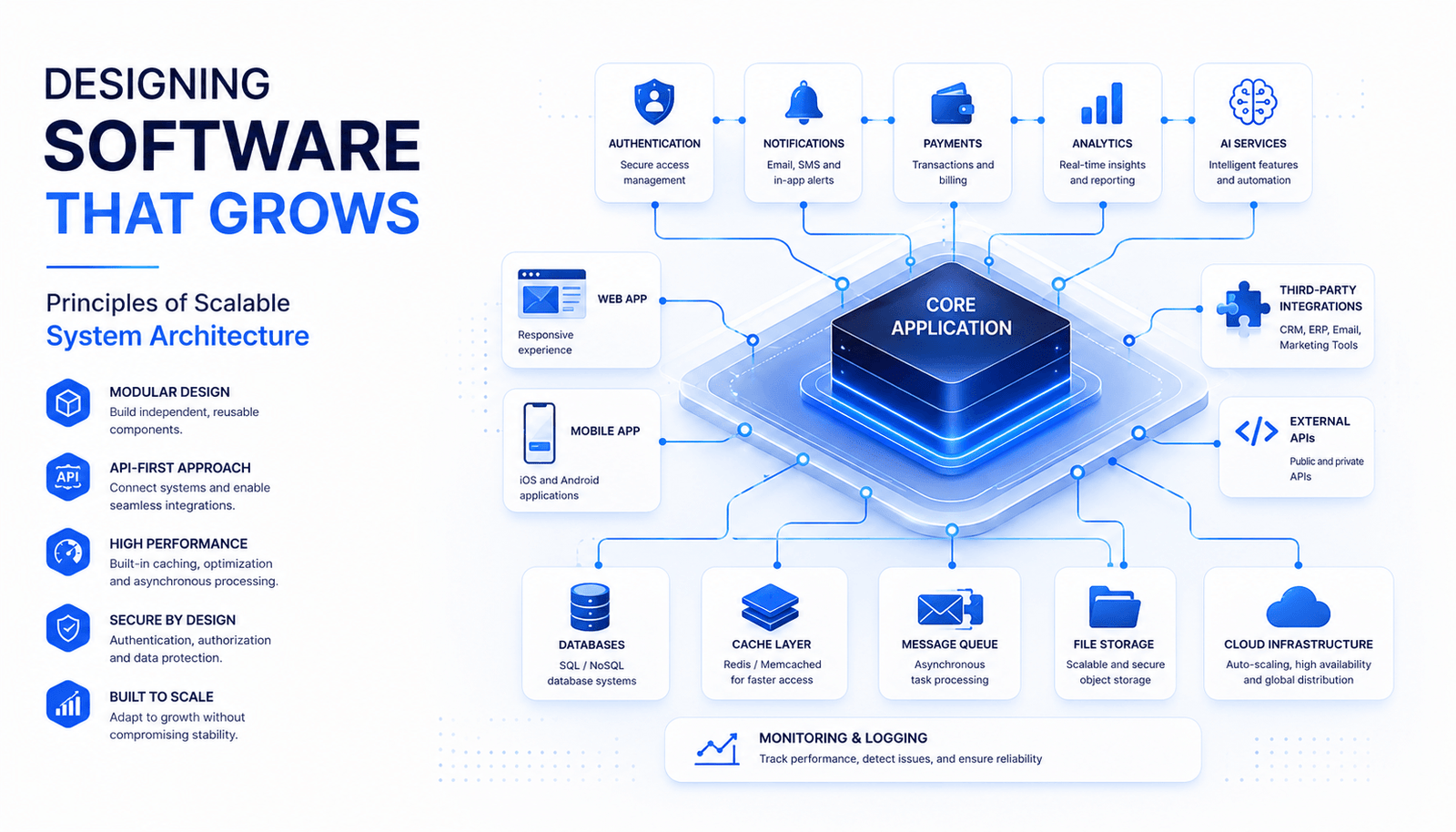
Modular architecture helps prevent this problem by dividing the application into smaller, well-defined components. Authentication should focus solely on user identity. Payment services should manage transactions without controlling notifications. Reporting should consume business data without containing business logic itself. Each module has a specific responsibility and exposes only the functionality that other modules genuinely require.
This separation makes software significantly easier to maintain. Teams can improve one area of the application without understanding every detail of the entire codebase. As the product expands, new functionality can often be introduced by extending existing modules rather than rewriting large sections of the system.
APIs Make Modern Software Future-Ready
Today's software rarely operates in isolation. Businesses rely on websites, mobile applications, payment providers, customer relationship management platforms, marketing tools, analytics services, and increasingly, AI-powered solutions. All of these systems need a reliable way to exchange information.
This is where APIs become one of the most valuable architectural investments a development team can make. Well-designed APIs create consistent communication between different parts of the business while keeping individual systems loosely connected. A website can retrieve customer information from a CRM, process payments through a third-party provider, trigger automated workflows, and deliver personalised experiences without tightly coupling every service together.
An API-first mindset also prepares businesses for future opportunities. Whether the next project involves a mobile application, an AI assistant, a partner integration, or a customer portal, much of the existing infrastructure can already support it because the underlying architecture was designed for connectivity rather than isolation.
Design Systems That Expect Change
One of the few constants in software development is change. Customer expectations evolve, regulations change, businesses enter new markets, and emerging technologies create new opportunities. Applications that assume requirements will remain fixed often become difficult to adapt within just a few years.
Rather than attempting to predict every possible future scenario, scalable architecture focuses on making change less expensive. Clear interfaces, reusable components, loosely coupled services, and consistent coding standards all contribute to software that can evolve without requiring major redesigns.
This doesn't mean over-engineering every project from the beginning. Instead, it means making thoughtful decisions that preserve flexibility. Simple abstractions today often save hundreds of development hours in the future when the business inevitably changes direction.
Performance Starts With Architecture
Performance optimisation is frequently treated as the final phase of development. Teams build the application first and only begin addressing speed when customers start complaining. Unfortunately, many performance issues originate from architectural decisions made months or even years earlier.
Efficient applications are designed with performance in mind from the start. Database queries are structured carefully, caching strategies are considered early, background processing handles time-consuming tasks, and APIs return only the information users actually need. These decisions may seem technical, but their impact extends directly to business outcomes.
Fast applications create smoother user experiences, improve search engine visibility, increase customer confidence, and often lead to higher conversion rates. Performance should therefore be viewed as a core architectural principle rather than an optional optimisation exercise.
Simplicity Is Often the Most Scalable Solution
Developers naturally enjoy solving complex problems, but complexity isn't always a sign of better engineering. In many projects, unnecessary abstractions, excessive design patterns, and overly complicated workflows make software harder to understand than it needs to be.
Scalable systems often achieve their reliability through simplicity. Clear naming conventions, predictable project structures, reusable components, and straightforward communication between services reduce cognitive overhead for every developer working on the application.
Simple software is easier to test, easier to debug, and easier to extend. It also reduces onboarding time for new team members and allows businesses to respond more quickly when priorities change. As projects mature, simplicity consistently proves to be one of the most valuable architectural decisions a team can make.
Technology Will Change, Principles Will Not
Every few years, a new framework becomes the centre of attention. Development communities shift their focus, libraries evolve, and businesses begin adopting the latest tools. While keeping up with technology is important, sustainable software is rarely defined by the framework it uses.
Applications built with strong architectural principles remain valuable long after individual technologies change. Whether a business uses WordPress, Laravel, React, Next.js, .NET, or another platform, the same foundational ideas continue to apply. Clear separation of responsibilities, modular design, reliable APIs, maintainable code, and performance-focused thinking remain relevant regardless of the technology stack.
Businesses that invest in architecture instead of chasing trends place themselves in a much stronger position. Adopting new technologies becomes significantly easier because the underlying system has already been designed to evolve.
Architecture Is a Long-Term Business Investment
Strong software architecture rarely attracts attention during product demonstrations. Customers don't see clean code, modular services, or well-designed APIs. What they experience instead is a product that feels fast, reliable, and continuously improving.
The true value of architecture becomes visible over time. Development teams release new features more confidently, integrations take weeks instead of months, performance remains consistent as user numbers grow, and the software continues supporting new business initiatives without constant redevelopment.
These outcomes don't happen by accident. They result from architectural decisions made early in the project's lifecycle, often long before the business fully understands how much the application will eventually grow.
Final Thoughts
Scalable system architecture isn't about preparing for millions of users on the first day of development. It's about creating software that remains adaptable as the business evolves, customer expectations change, and new opportunities emerge. Applications built on strong architectural principles continue delivering value because they are designed to support growth rather than resist it.
Businesses often invest heavily in choosing the right framework, cloud provider, or development tools. While those decisions matter, they should never overshadow the importance of thoughtful architecture. Technologies will continue to evolve, but well-designed systems remain resilient because they prioritise maintainability, flexibility, performance, and simplicity from the very beginning.
The most successful software isn't remembered because it used the latest technology. It's remembered because years after its first release, it continues to solve business problems, support innovation, and grow alongside the organisation it was built to serve.
Share this article