Artificial intelligence has become one of the biggest topics in business, yet most conversations focus on the wrong things. Headlines often highlight AI-generated images, chatbots, or concerns about jobs being replaced. While these discussions capture attention, they overlook where the real transformation is taking place.
The biggest AI revolution isn't happening where customers can see it. It's happening inside businesses.
Across industries, organisations are quietly redesigning how work gets done. Employees are spending less time searching for information, copying data between systems, preparing reports, and managing repetitive administrative tasks. Instead, intelligent systems are beginning to handle much of this routine work, allowing people to focus on solving problems, serving customers, and making strategic decisions.
Most customers will never realise these changes are happening. They will simply notice that companies respond faster, deliver better service, and make fewer mistakes. Behind every one of those improvements is an invisible layer of intelligence that is reshaping the way modern businesses operate.
Unlike previous waves of digital transformation that focused on moving businesses online or adopting cloud software, artificial intelligence is changing something much more fundamental. It is changing how decisions are made, how information flows, and how every department collaborates.
For business leaders, this shift is no longer a future trend. It is becoming a competitive advantage.
AI Isn't Changing One Department—It's Changing the Entire Business
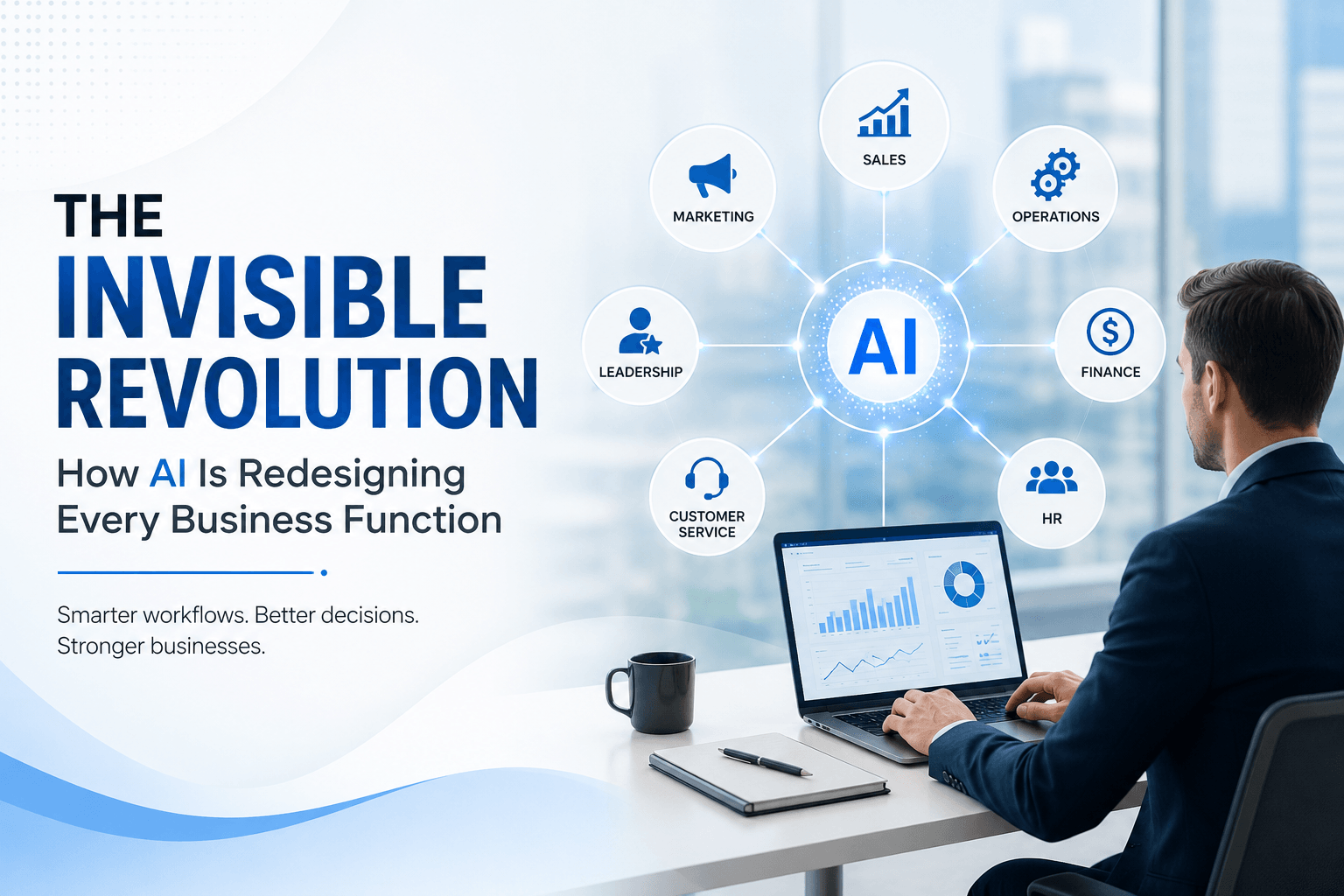
Many organisations still think of artificial intelligence as another tool for a specific team. Marketing uses AI for content. Customer service uses chatbots. Finance automates invoices.
In reality, AI creates its greatest value when it becomes part of the entire organisation rather than one isolated department.
Think about how a single customer enquiry moves through a business. A prospect submits a contact form. The sales team follows up. Marketing tracks the campaign source. Finance prepares a quotation. Operations plan delivery. Customer service handles future support.
Traditionally, every handoff between these departments required someone to manually transfer information, update software, send emails, or schedule the next step.
Artificial intelligence is removing many of those handoffs.
Instead of waiting for employees to move information from one system to another, AI can automatically qualify enquiries, update CRM records, notify the right departments, generate documents, assign tasks, and keep everyone informed throughout the process.
The result isn't simply faster work. It is a business that operates with far less friction.
Sales Teams Are Spending More Time Selling
Every salesperson knows that selling involves far more administration than customers realise.
Researching prospects, updating CRM records, writing follow-up emails, preparing meeting notes, scheduling appointments, and analysing opportunities often consume hours that could be spent building relationships.
Artificial intelligence is helping sales professionals reclaim that time.
Instead of manually performing these repetitive activities, AI can support the sales process by:
Qualifying new leads automatically.
Researching companies before meetings.
Summarising customer conversations.
Suggesting follow-up actions.
Updating CRM records.
Drafting personalised outreach emails.
These capabilities don't replace experienced sales professionals. They remove repetitive digital work so sales teams can focus on understanding customer challenges and closing deals.
That is where human expertise continues to create the greatest value.
Marketing Is Becoming More Predictive Than Reactive
Marketing has never suffered from a lack of data. It suffers from having too much of it.
Businesses collect information from websites, advertising campaigns, social media, email platforms, CRM systems, customer surveys, and countless analytics tools. Turning that data into actionable decisions has traditionally required significant manual effort.
Artificial intelligence changes that equation.
Instead of spending days analysing reports, marketing teams can quickly identify customer behaviour, predict campaign performance, discover emerging trends, and personalise experiences for different audiences.
AI isn't replacing creativity.
It is ensuring creative decisions are supported by better intelligence.
The result is marketing that becomes less dependent on assumptions and more focused on measurable outcomes.
Operations Are Becoming the Biggest Winner
While AI-generated content often attracts public attention, operations may be where artificial intelligence creates the greatest business value.
Every organisation depends on hundreds of small operational activities happening every day. Approvals, inventory updates, project coordination, procurement, scheduling, reporting, and internal communication all keep the business moving.
Individually, these tasks seem small.
Collectively, they consume thousands of employee hours every year.
Artificial intelligence helps eliminate these hidden inefficiencies by monitoring workflows, identifying bottlenecks, coordinating approvals, triggering automated actions, and ensuring business processes continue without unnecessary delays.
Customers rarely notice these improvements directly.
They simply experience faster deliveries, quicker responses, and more reliable service.
Leadership Is Gaining Something More Valuable Than Automation
Most discussions about AI focus on automation.
For executives, however, the greatest benefit is intelligence.
Business leaders have always relied on reports to understand company performance. The problem is that reports usually describe what happened yesterday, last week, or last month.
Artificial intelligence allows leaders to understand what is happening right now.
By analysing information across finance, operations, sales, customer service, and marketing, AI provides real-time insights, identifies emerging risks, predicts future trends, and supports faster strategic decisions.
Instead of reacting to problems after they occur, leaders gain the opportunity to prevent them altogether.
That shift from reactive management to proactive leadership may become one of artificial intelligence's most valuable contributions.
The Businesses That Win Will Make AI Invisible
The companies gaining the greatest value from artificial intelligence are not necessarily the ones buying the most AI software.
They are the organisations that make AI almost invisible.
Employees don't need to think about AI every time they complete a task.
Customers don't need to know AI helped process their request.
Instead, intelligence becomes embedded throughout the business, quietly improving every workflow, every decision, and every customer interaction.
When AI disappears into the background, productivity moves to the foreground.
That is when businesses begin operating faster, smarter, and more efficiently without changing how customers experience the brand.
Final Thoughts
Artificial intelligence is not redesigning business through one revolutionary application. It is transforming organisations through thousands of small improvements that happen every day.
Sales teams spend more time selling. Marketing teams make better decisions. Operations become more efficient. Leaders gain deeper insights. Employees focus on meaningful work instead of repetitive administration.
Individually, these changes may seem incremental.
Together, they represent one of the most significant shifts in modern business.
The invisible revolution isn't about replacing people with technology. It is about building organisations where intelligent systems handle routine digital work while people focus on creativity, strategy, relationships, and innovation.
Businesses that recognise this shift today won't simply become more efficient. They'll be better equipped to adapt, compete, and lead in an increasingly intelligent economy.
Share this article