The way businesses build software has changed dramatically over the past decade. Not long ago, companies invested in standalone applications that performed a single function. Customer information lived inside a CRM, financial records remained in accounting software, inventory was managed through a separate platform, and the company website operated almost independently from the rest of the business. While these systems served their individual purposes, they rarely communicated with one another, forcing employees to manually transfer information between applications and creating inefficiencies that slowed business growth.
Today, that model is rapidly disappearing. Modern businesses no longer compete based solely on the software they own—they compete on how effectively their software works together. Behind every seamless online experience lies a network of connected systems exchanging information in real time. Whether a customer places an online order, books an appointment, submits a support request, or signs up for a service, multiple applications are working together behind the scenes to complete a single task. This interconnected approach has given rise to what many technology leaders now call the API economy.
The API economy isn't simply about technology. It represents a new way of thinking about software, where applications are no longer isolated products but parts of a much larger digital ecosystem. Businesses that embrace this approach are becoming faster, more efficient, and better prepared for the future because their systems can communicate, automate processes, and adapt to changing business needs.
Understanding the API Economy
Application Programming Interfaces, commonly known as APIs, are often described as tools that allow software systems to communicate. While that definition is technically correct, it doesn't fully explain their business value.
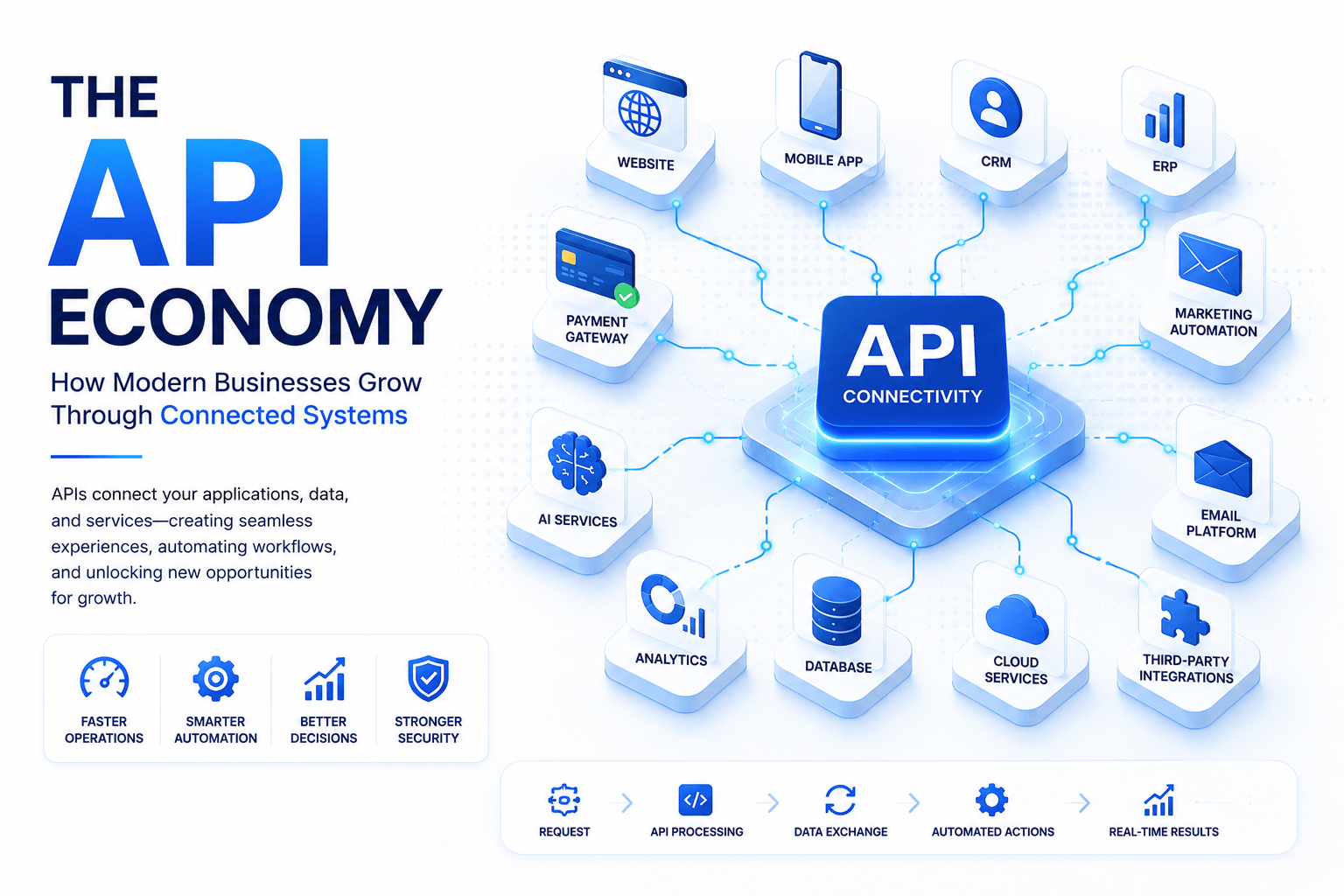
Think about a customer purchasing a product from an online store. From the customer's perspective, the process appears remarkably simple. They browse products, complete payment, receive an email confirmation, and wait for delivery. Behind that seemingly straightforward experience, however, numerous systems are exchanging information within seconds.
The website communicates with a payment gateway to process the transaction. Inventory management updates product availability. The CRM records customer activity. Accounting software generates invoices. Shipping platforms receive delivery information. Marketing systems trigger follow-up emails, while analytics platforms record customer behaviour for future insights.
Each of these interactions is made possible through APIs.
Rather than forcing employees to manually move information between systems, APIs allow applications to exchange data instantly and securely. This ability to connect software has transformed APIs from technical development tools into critical business assets.
Connected Systems Create Better Businesses
Modern organisations rarely rely on a single software platform to operate. Instead, they use specialised applications designed for different business functions. Customer relationship management, accounting, marketing automation, inventory management, customer support, communication platforms, and business intelligence tools all play unique roles within an organisation.
The real competitive advantage emerges when these systems stop operating independently.
Imagine a sales representative closing a deal. Instead of manually notifying multiple departments, the CRM can automatically update financial records, trigger contract generation, notify project managers, create onboarding tasks, schedule welcome emails, and generate internal reports. What once required hours of administrative work can now happen within seconds.
This level of connectivity improves efficiency while reducing human error. Employees spend less time transferring information between systems and more time focusing on activities that create value for customers.
As businesses continue adopting cloud-based software, the ability to connect these platforms has become just as important as choosing the platforms themselves.
APIs Have Become the Infrastructure of Digital Experiences
Many people interact with APIs every day without realising they exist. Every time someone requests a ride through a transportation app, tracks a food delivery, checks a bank balance, signs in using a Google account, or receives personalised recommendations while shopping online, APIs are coordinating multiple systems behind the scenes.
The user experiences a single application.
The business manages an entire ecosystem.
This invisible infrastructure allows organisations to combine services from multiple providers without building everything themselves. Payment gateways, mapping services, authentication platforms, communication tools, cloud storage, AI models, and analytics solutions can all become part of a single customer experience through well-designed APIs.
Instead of rebuilding common functionality from scratch, businesses can focus on solving unique problems while leveraging specialised services that already exist.
The Rise of API-First Businesses
Traditionally, software was often designed around the user interface first. Developers built websites or applications and considered integrations later as business needs evolved. This approach frequently resulted in disconnected systems and expensive redevelopment projects whenever new requirements emerged.
Modern software development increasingly follows an API-first approach.
Rather than treating APIs as secondary features, businesses design them as core components of their architecture from the beginning. Every service communicates through clearly defined interfaces, making future integrations significantly easier.
This strategy provides long-term flexibility. A company that launches with a website today may decide to build a mobile application next year, introduce AI-powered customer support the following year, and later expand into partner integrations or customer portals. When the underlying architecture is API-first, these new digital products can be introduced without redesigning the entire system.
The result is software that grows alongside the business instead of limiting future innovation.
APIs Are Fueling Business Automation
Automation has become one of the most significant drivers of digital transformation. Businesses are constantly searching for opportunities to eliminate repetitive work, reduce operational costs, and improve productivity. APIs play a central role in making this possible.
Consider a recruitment agency receiving a new job application. Instead of downloading resumes, updating spreadsheets, sending confirmation emails, notifying recruiters, and creating follow-up tasks manually, APIs allow these actions to happen automatically.
The website receives the application.
The CRM stores candidate information.
Email software sends confirmation messages.
Internal project management systems assign review tasks.
Communication platforms notify recruiters instantly.
Everything happens within moments, without requiring manual intervention.
This level of automation enables businesses to scale operations without proportionally increasing administrative workloads.
Artificial Intelligence Depends on Connected Systems
Artificial intelligence has quickly become one of the most influential technologies in modern business. Yet AI alone delivers limited value if it cannot interact with the systems that store business information.
An AI assistant cannot update customer records if it has no access to the CRM. It cannot generate invoices without communicating with accounting software. It cannot schedule appointments without connecting to calendar systems.
This is why APIs have become essential for successful AI adoption.
They provide the bridge between intelligent software and business operations.
Modern AI agents rely heavily on APIs to retrieve information, execute tasks, trigger workflows, analyse business data, and interact with multiple applications simultaneously. Without connected systems, AI becomes little more than an isolated chatbot. With strong API infrastructure, however, AI evolves into an intelligent business assistant capable of supporting real operational processes.
As organisations continue investing in artificial intelligence, the quality of their API ecosystem will increasingly determine how much value AI can actually deliver.
Security and Governance Cannot Be Overlooked
As businesses become more connected, protecting those connections becomes increasingly important. APIs frequently exchange sensitive information, including customer records, financial transactions, employee data, and confidential business operations.
Strong API governance ensures that only authorised systems can access protected information. Authentication, encryption, rate limiting, monitoring, version management, and access controls all contribute to secure and reliable integrations.
Security should never be viewed as an obstacle to innovation. Instead, it provides the confidence businesses need to connect systems without exposing critical data or creating unnecessary operational risks.
Well-managed APIs not only improve security but also create a stable foundation for long-term digital growth.
The Future Belongs to Connected Digital Ecosystems
The software landscape continues evolving at an extraordinary pace. Businesses are adopting AI, automation platforms, cloud-native applications, IoT devices, customer portals, and advanced analytics faster than ever before. Each new technology adds value only when it can communicate effectively with the rest of the organisation.
This is why the future isn't about owning more software.
It's about building better connections between the software you already use.
Companies that invest in connected systems gain greater flexibility, faster innovation, and the ability to respond quickly as customer expectations change. Instead of replacing existing applications whenever new opportunities emerge, they extend their capabilities through intelligent integrations.
The API economy makes this possible by transforming isolated applications into collaborative digital ecosystems that continuously exchange information and create value.
Final Thoughts
The API economy represents far more than a technological trend. It reflects a fundamental shift in how modern businesses operate, compete, and innovate. APIs have become the invisible infrastructure that powers customer experiences, automates workflows, connects business platforms, and enables emerging technologies such as artificial intelligence.
Businesses that continue treating software as isolated systems will find it increasingly difficult to keep pace with digital transformation. In contrast, organisations that invest in connected architectures create environments where information flows freely, automation becomes practical, and innovation happens much faster.
The most successful companies of the next decade won't necessarily be those with the largest number of applications. They'll be the ones whose applications work together seamlessly, creating intelligent digital ecosystems that improve efficiency, enhance customer experiences, and support sustainable business growth.
Share this article