Design systems have traditionally been created to help humans build digital products consistently. Designers use them to establish visual rules, developers use them to implement reusable components, and product teams use them to maintain a consistent experience across applications. But as AI agents become increasingly involved in designing, building, navigating, and interacting with digital interfaces, the role of a design system is beginning to change.
A modern design system may no longer serve only designers and engineers. It can also become a source of structured context for intelligent software.
This creates an important shift in how design systems should be approached. A collection of components inside a design tool is useful, but it isn't necessarily a complete design system. The systems that are most prepared for an agentic web are those that clearly define their components, relationships, constraints, behaviours, states, accessibility requirements, and design decisions in a way that both people and machines can understand.
The future of design systems may therefore be less about creating more components and more about creating better structured knowledge around those components.
The Design System Is Becoming More Than a Component Library
For many teams, a design system is still viewed primarily as a collection of reusable UI components. Buttons, cards, forms, modals, navigation elements, typography, colours, and spacing rules are documented and made available to designers and developers.
This approach solves an important problem: consistency.
Instead of every designer creating a slightly different button or every developer implementing their own version of a form, the design system provides a shared foundation. Teams can move faster while maintaining a predictable visual language.
But components alone don't contain the complete meaning of an interface.
A button isn't simply a rectangle with text inside it. It has a purpose, states, interaction rules, accessibility requirements, hierarchy, and behavioural expectations. A form isn't just a collection of input fields. It represents a workflow with validation, errors, permissions, and a desired outcome.
Humans can often infer these relationships from context.
Machines need them to be made explicit.
That distinction becomes increasingly important as AI agents begin interacting with design and development systems.
AI Agents Need Context, Not Just Components
An AI agent can generate a button component relatively easily. The more difficult problem is determining which button should be used, why it should be used, what state it should have, and what rules govern its behaviour.
Imagine a design system containing three button components: primary, secondary, and destructive.
A human designer can read the documentation and understand that the primary button represents the most important action on a page, the secondary button represents a supporting action, and the destructive button should be used for irreversible operations.
An agent needs access to that same context.
Without it, an AI system may technically use the correct component while making the wrong design decision.
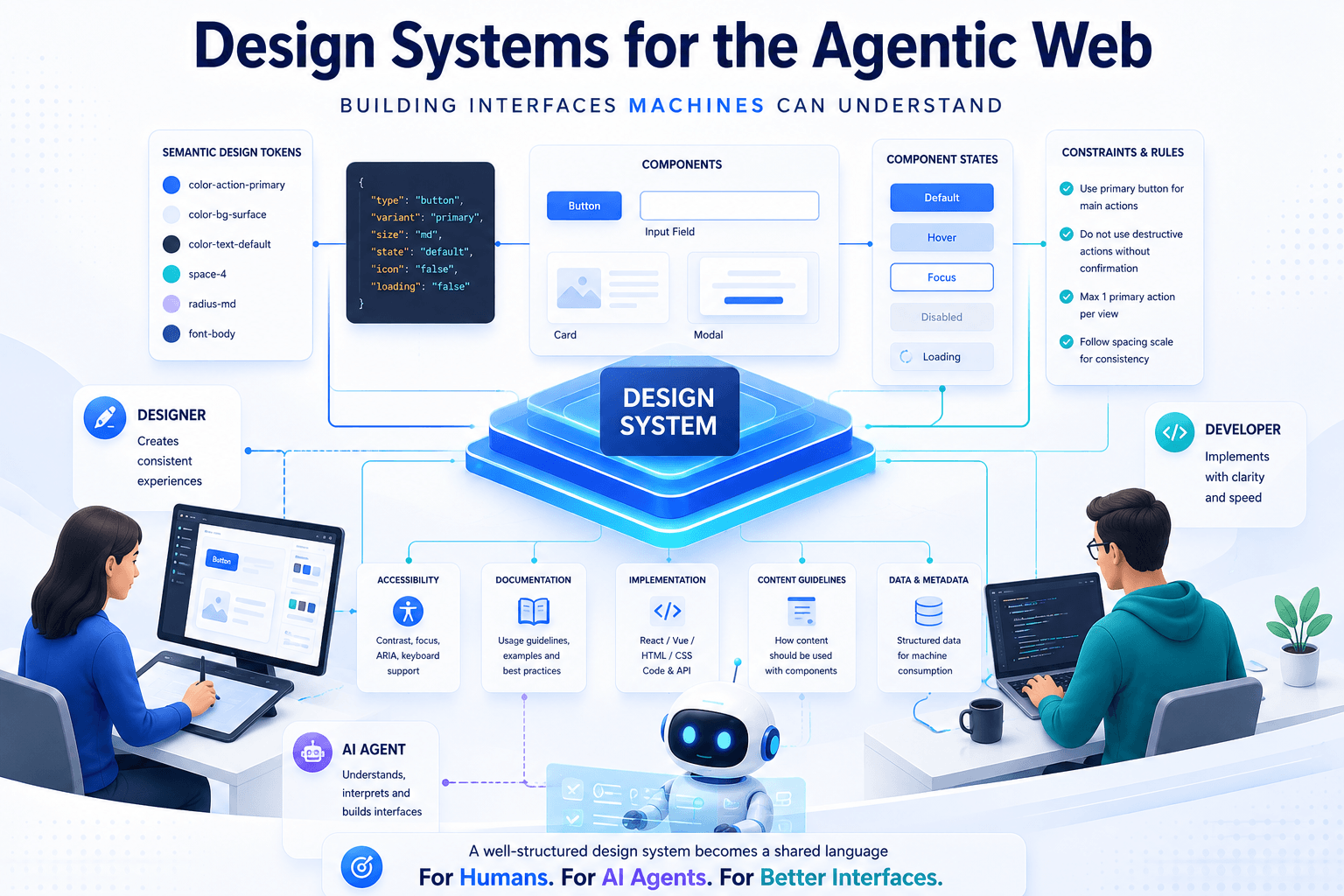
This is why agent-ready design systems need more than reusable code. They need structured information about the intent behind the components.
The system should make it possible to understand not only what a component is, but also when, where, and why it should be used.
Design Tokens Become Structured Infrastructure
Design tokens are often treated as variables for colours, spacing, typography, borders, shadows, and other visual properties. They help designers and developers maintain consistency and make global changes more efficiently.
But their value becomes much greater when they are structured semantically.
Consider a token called:
blue-500
It describes a colour value, but it doesn't necessarily explain why that colour exists.
A semantic token such as:
color-action-primary
contains more meaning. It communicates that the value represents a primary action within the interface.
This distinction matters when systems need to be interpreted by machines.
Semantic tokens provide context that can be used across design tools, codebases, documentation, accessibility systems, themes, and potentially AI-powered development workflows.
A well-structured token system can therefore become more than a styling mechanism. It can become part of the language through which an organisation describes its interface.
Naming Is an Architectural Decision
Clear naming has always been useful for developers, but the importance of naming increases when machines need to interpret a system.
Consider components named Box1, CardNew, and Button2.
A human who created the system may understand what they mean, but the names provide very little information to someone else—or to an AI system working without the original designer's context.
Compare that with names such as ProductCard, PrimaryActionButton, AccountSummary, or DestructiveAction.
The second approach communicates intent.
The same principle applies to tokens, component properties, variants, states, and documentation.
Naming should explain the role of an element rather than simply describing its appearance.
This is one of the simplest ways teams can make their systems easier to understand without introducing another technology or framework.
Component States Are Part of the Meaning
A component rarely has only one state.
A button can be default, hover, focused, pressed, disabled, loading, or in an error-related state. A form field can be empty, filled, focused, invalid, valid, disabled, or read-only.
These states aren't merely visual variations.
They represent different stages of interaction.
An agent generating or modifying an interface needs to understand these relationships. Otherwise, it may produce a visually correct component that behaves incorrectly.
A mature design system should therefore describe states as part of the component's definition rather than treating them as optional visual examples.
This becomes particularly important for accessibility and interaction design. Keyboard focus, error states, loading behaviour, and disabled controls all communicate information that should remain consistent across the product.
Constraints Give AI Systems Boundaries
Good design systems don't only tell teams what they can use. They also establish what they shouldn't do.
A component might have a maximum number of items. A navigation system might support only certain levels of hierarchy. A particular card might be intended for short descriptions rather than large amounts of content. A spacing system might follow a defined scale instead of allowing arbitrary values.
These constraints are extremely valuable.
Without constraints, an AI system can generate something technically valid but inconsistent with the product's design language.
With explicit constraints, the system can reason within boundaries.
This is similar to the role constraints play in software architecture. They reduce ambiguity and prevent every implementation from becoming a new interpretation of the same problem.
A design system that clearly defines its constraints becomes easier to use, easier to maintain, and potentially easier for AI systems to work with.
Documentation Becomes Part of the System
Documentation has traditionally been treated as something that explains the design system.
In an agentic development environment, documentation increasingly becomes part of the system itself.
Good documentation can explain component purpose, usage guidelines, variants, accessibility requirements, interaction behaviour, content recommendations, and implementation details.
This gives both humans and machines the context required to make better decisions.
Poor documentation forces developers to rely on tribal knowledge. A designer may know that a particular component should only be used in a specific workflow, but that knowledge may never be recorded anywhere.
When that designer leaves the project, the knowledge disappears.
A structured design system captures this knowledge and makes it reusable.
That is especially valuable when AI tools become part of the development workflow because the quality of the context provided to the AI directly influences the quality of the output.
Design Tokens, Components, and Code Need to Stay Connected
Another major challenge is the separation between design tools and production code.
A team may have one definition of a component inside a design tool, another implementation in a frontend repository, and a third description inside documentation.
Over time, these representations can drift apart.
The design file may show one version of a component. The codebase may implement another. The documentation may describe an older version.
Humans can sometimes recognise and correct these inconsistencies.
Automated systems have a much harder time doing so.
The more closely design tokens, components, documentation, and production code are connected, the easier it becomes to maintain a reliable source of truth.
This is one reason modern design-system architecture is increasingly moving toward structured, interoperable representations rather than treating the design file as the entire system.
Accessibility Rules Should Be Built Into the System
Accessibility is another area where structured design systems become extremely valuable.
Instead of expecting every designer or developer to remember every accessibility requirement for every component, those requirements can become part of the component's definition.
A modal can include focus-management requirements.
A form field can define label and error relationships.
A button can define keyboard interaction expectations.
A colour token can be associated with contrast requirements.
A design system that encodes these rules reduces the likelihood of accessibility becoming an afterthought.
It also creates useful context for automated development tools.
An AI system generating an interface should not simply know how a component looks. It should understand the accessibility constraints that accompany that component.
This turns accessibility from a checklist into an architectural property of the system.
The Agentic Design System
The next generation of design systems may therefore look very different from the traditional component library.
Instead of simply containing visual components, a mature system could contain several layers of structured information.
The visual layer defines how components look.
The semantic layer defines what they mean.
The behavioural layer defines how they work.
The constraint layer defines where and how they can be used.
The accessibility layer defines requirements for inclusive interaction.
The implementation layer connects those definitions to production code.
The documentation layer explains the reasoning behind the system.
Together, these layers create something much more powerful than a collection of reusable components.
They create a structured representation of the product's interface language.
That is the kind of system that can provide meaningful context to AI agents.
This Changes the Role of Designers and Developers
The emergence of agent-ready design systems doesn't make designers or developers less important.
It changes where some of their value is created.
When AI can generate components quickly, the difficult problem becomes defining the rules that determine whether those components are correct.
Designers increasingly need to think about systems, relationships, constraints, and semantics rather than individual screens alone.
Developers increasingly need to think about how design decisions can be represented in reusable, structured, and machine-readable forms.
The role shifts from producing every individual interface element toward building the system that allows interfaces to be produced consistently.
In that sense, AI may make strong design systems more valuable rather than less valuable.
A Component Library Is Not Enough
There is an important distinction between having a component library and having a genuine design system.
A component library gives a team reusable building blocks.
A design system provides the rules and context that explain how those building blocks should work together.
A library might tell you that a Card component exists.
A design system should tell you what the card represents, when it should be used, what content it supports, what variants are available, how it behaves across screen sizes, how it should be accessed, and what components it can work with.
This difference becomes increasingly significant in an environment where AI systems can generate interfaces automatically.
The more ambiguous the system is, the more interpretation is required.
The more structured it is, the more reliably an agent can work within it.
The Future of Design Systems Is Structured
The agentic web is still evolving, and there is no single standard for what an agent-ready design system should look like.
However, the direction is becoming increasingly clear.
Design systems are moving beyond static collections of visual components toward structured systems of meaning, behaviour, constraints, and implementation.
The teams that have already invested in clear naming, semantic tokens, reusable components, accessibility rules, strong documentation, and consistent architecture may discover that they have unintentionally built something valuable for the agentic era.
Their systems don't just help people build interfaces.
They provide context that machines can potentially understand and use.
Teams that have treated their design system as nothing more than a collection of components attached to a design file may face a different challenge. As AI-assisted development becomes more capable, the absence of structured context can become a significant limitation.
The gap won't necessarily be between companies that use AI and companies that don't.
It may increasingly be between companies whose systems provide high-quality context and those whose systems don't.
Final Thoughts
The rise of the agentic web is changing the way we think about interfaces. Websites are becoming more than visual experiences for human users; they are becoming structured environments that intelligent software can understand and interact with.
Design systems sit at the centre of this transition.
Tokens, components, semantics, constraints, behaviours, accessibility rules, documentation, and implementation details all contribute to the context required to build reliable interfaces. When these elements are structured clearly, they become useful not only to designers and engineers but also to the AI systems increasingly participating in the development process.
The future design system may therefore not be the one with the largest component library.
It may be the one with the clearest language, strongest rules, and richest context.
Because in an agentic web, the question is no longer simply whether a machine can generate an interface.
The more important question is whether the system gives that machine enough understanding to generate the right interface.
Share this article