For more than three decades, the web has been designed around one fundamental assumption: a human is on the other side of the screen.
Websites were built around pages, menus, buttons, forms, search boxes, and visual interfaces because people were expected to navigate them. A user would visit a website, read information, make decisions, click through different pages, complete a form, and eventually accomplish a task.
That model still works, and it isn't going away.
But something important is changing.
AI agents are increasingly becoming another way people interact with the internet. Instead of manually searching for a product, comparing options, filling out forms, or navigating complicated workflows, a user can increasingly delegate those tasks to an AI system. The agent can interpret the user's intent, interact with websites, retrieve information, and in some cases perform actions on the user's behalf.
This creates a new challenge for web developers. Websites now need to work well for humans while becoming increasingly understandable and actionable for intelligent software.
This emerging shift is often described as the agentic web.
The Web Was Designed for Human Interaction
The architecture of the web has always reflected human behaviour.
HTML provides structure and content. CSS controls presentation. JavaScript creates interaction. Forms collect information. Buttons trigger actions. Navigation helps users move between pages.
These technologies have evolved considerably, but the underlying assumption has remained relatively consistent: a person is interpreting the interface and deciding what to do next.
A human can look at a product page and immediately understand that a blue button labelled "Add to Cart" is an action. A person can recognise that a calendar contains available appointment times. They can understand that a particular form is asking for their shipping address even when the surrounding interface contains additional visual elements.
AI agents don't necessarily interpret interfaces in the same way.
An agent can use a browser and simulate clicks and text input, but this can be slower and more fragile because the agent has to infer what each element means and determine which sequence of actions will accomplish the user's goal. Google's WebMCP work is exploring a more structured approach in which websites can explicitly expose capabilities to agents rather than forcing them to infer every interaction from the visual interface.
This represents a significant change in how we think about web interfaces.
From Responsive to Adaptive to Agentic
The evolution of web development can be viewed as a series of adaptations.
Responsive design taught websites to adapt to different screen sizes. A desktop layout could transform into a mobile layout without requiring completely separate websites.
Adaptive experiences expanded that idea by considering more than screen dimensions. Websites can respond to accessibility preferences, network conditions, device capabilities, user behaviour, and other contextual signals.
The agentic web introduces another dimension.
A website now needs to consider that some visitors may not interact with the interface directly at all. An AI agent may act as an intermediary between the person and the website.
The interaction could look something like this:
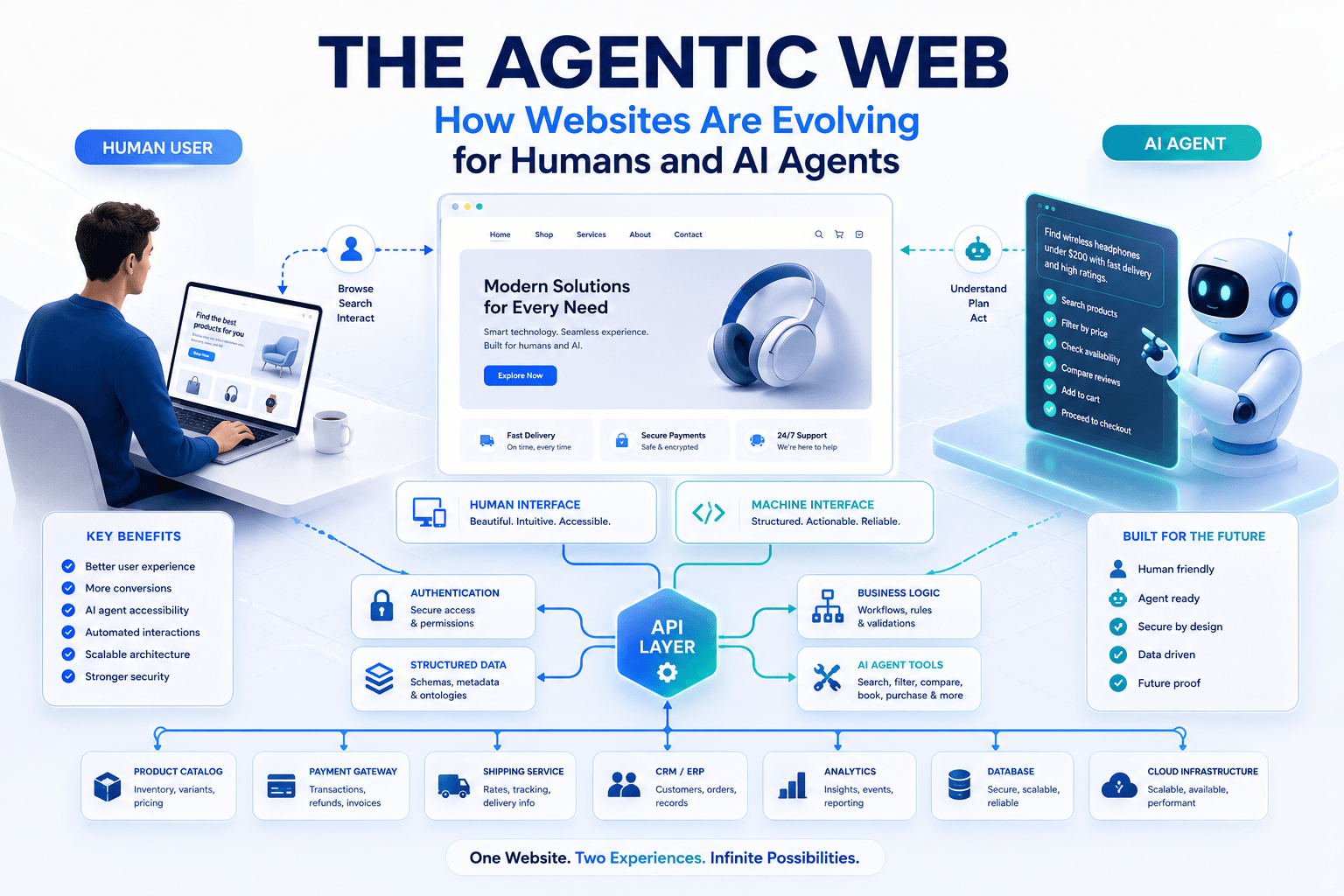
Human → AI Agent → Website → Business System
The user expresses an intention. The agent interprets that intention. The website provides the information or capabilities required to accomplish the task. The underlying business systems then execute the operation.
The website remains important, but its role becomes broader.
It becomes both a human interface and a machine-actionable interface.
AI-Readable Is Not the Same as AI-Actionable
One of the most important distinctions in this transition is the difference between a website that an AI can understand and one that an AI can actually use.
A website may contain well-written product descriptions, structured metadata, semantic HTML, and clear navigation. This makes the information easier for machines to interpret.
But understanding information is only one part of the problem.
Imagine an e-commerce website selling thousands of products. An AI agent might be able to understand the product catalogue, but the real value appears when it can perform actions such as searching products, filtering by price and availability, comparing options, adding an item to a cart, or starting a checkout process.
That requires actionability.
Google's WebMCP documentation describes this direction explicitly, with websites exposing structured tools for actions such as searching, filtering, booking, and purchasing. The goal is to give agents clearer instructions about what a website can do instead of making them infer every interaction from the page itself.
The distinction is important because the next generation of websites won't simply need to provide information to AI systems. They will increasingly need to provide capabilities.
APIs Become Even More Important
This development makes the API economy we discussed previously even more significant.
APIs already allow websites and applications to communicate with CRMs, payment gateways, inventory systems, analytics platforms, ERPs, and other business services. AI agents add another consumer to this ecosystem.
Consider an online store.
A traditional customer visits the website, searches for a product, selects a variant, adds it to a cart, and completes checkout.
An AI-assisted customer might instead say:
"Find a waterproof hiking jacket under $200, available in medium, with delivery this week."
For an agent to accomplish that reliably, the underlying system needs much more than attractive product pages.
It needs structured product information, accurate inventory, pricing, variants, shipping information, search capabilities, and secure transaction workflows.
The website becomes the visible layer of a much larger system.
This is why the agentic web isn't simply a frontend trend. It is an architectural shift that connects frontend experiences, APIs, business systems, structured data, and AI agents.
Semantic HTML Matters More Than Ever
The rise of AI agents doesn't make traditional web standards less important. In many cases, it makes them more valuable.
Semantic HTML gives meaning to the structure of a page. Proper headings, forms, labels, buttons, navigation elements, and other semantic elements help browsers, assistive technologies, search engines, and automated systems understand what a page contains.
A website that uses a visually styled <div> as a button may look perfectly fine to a human visitor. A properly implemented <button> communicates its purpose much more clearly to software.
The same principle applies throughout a website.
Clear structure, meaningful labels, predictable navigation, accessible forms, and consistent interaction patterns create a stronger foundation for both humans and machines.
Chrome's WebMCP best practices specifically recommend clear language and semantic HTML alongside deliberate tool design, schema handling, reliability, and testing.
Good web development practices are therefore becoming even more important—not less.
Websites Will Need Clearer Actions
Traditional websites often contain interfaces that make sense visually but are ambiguous from a machine's perspective.
Consider a button that simply says:
Continue
A human can usually understand its meaning from the surrounding context.
An AI agent has to determine what "Continue" actually does.
Does it proceed to checkout? Submit a form? Save changes? Move to the next step? Confirm a booking?
Agent-ready interfaces benefit from clearer action definitions.
Instead of designing interactions purely around visual appearance, developers will increasingly need to think about the intent behind every important action.
A tool such as search_products, book_appointment, or add_to_cart communicates considerably more meaning than a generic interaction that an agent has to infer.
This doesn't mean websites should expose technical implementation details to users. It means the underlying interface should provide enough structured information for software to interact with it reliably.
E-Commerce Could Be One of the Biggest Changes
E-commerce provides one of the clearest examples of how the agentic web could change user behaviour.
Today, purchasing something online often involves visiting multiple websites, comparing products, checking reviews, examining specifications, checking delivery options, and eventually completing checkout.
An AI agent could potentially compress much of that process.
A user might provide a set of requirements and allow an agent to search, compare, filter, and recommend suitable options. The user could then approve the final purchase rather than manually performing every step.
Research published in 2026 is already exploring this idea through the concept of agent-ready websites, focusing on machine readability, actionability, and decision reliability. In one preliminary experiment, an agent-ready e-commerce prototype substantially outperformed a human-oriented baseline on several shopping tasks.
This doesn't mean traditional online stores disappear.
It means the customer journey could acquire another layer.
Instead of only:
Customer → Store
we may increasingly see:
Customer → Agent → Multiple Stores
That could have major implications for product discovery, search, advertising, conversion, and e-commerce architecture.
Human Experience Still Comes First
It would be a mistake to interpret the agentic web as a reason to stop designing for people.
Humans are still the reason websites exist.
Customers still need to see products, understand services, build trust, review information, make important decisions, and sometimes take direct control of a transaction.
An AI agent should therefore complement the human experience rather than replace it.
This is also one of the interesting aspects of WebMCP's approach. Google's documentation describes exposed tools as operating on the website itself, allowing the existing human-centered design and user visibility to remain part of the experience.
The strongest websites of the future may therefore have two complementary interfaces.
One is visual and interactive for humans.
The other is structured and actionable for agents.
Both operate on the same underlying business capabilities.
Security Becomes a Much Bigger Concern
Giving AI agents the ability to interact with websites introduces an entirely different security model.
A human clicking a button is generally making an intentional decision based on what they see. An AI agent may be interpreting instructions, processing external content, and deciding which tools to call.
That creates new attack surfaces.
An agent could encounter malicious instructions hidden inside webpage content. A tool description could potentially contain instructions designed to manipulate the agent. An agent operating inside an authenticated browser session could also have access to sensitive information or actions that should not be performed automatically.
Chrome's current WebMCP security guidance specifically highlights threats including malicious tool definitions and contaminated outputs from otherwise trusted websites.
This means agent-ready development cannot simply be about making more actions available.
Developers will need to carefully consider authentication, authorization, permissions, validation, rate limiting, confirmation requirements, auditability, and the boundaries of what an agent is allowed to do.
The more powerful the agent becomes, the more important these controls become.
Agent-Ready Does Not Mean Giving AI Unlimited Access
There is an important difference between making a website usable by agents and giving agents unrestricted control over the website.
A well-designed agent interface should expose only the capabilities that are necessary.
For example, an e-commerce website might allow an agent to search products and compare prices without allowing it to complete a purchase without user confirmation.
A booking platform might allow an agent to find available appointments but require explicit approval before confirming one.
A banking application might allow an agent to retrieve certain information while placing strict restrictions around financial transactions.
The principle is similar to good software architecture: give each system the minimum capability it needs to perform its job.
Agentic systems make this principle even more important because the software performing the action may be operating with a degree of autonomy.
Web Development Is Becoming More Intentional
The agentic web doesn't necessarily require developers to throw away existing web technologies.
HTML still matters.
CSS still matters.
JavaScript still matters.
APIs still matter.
Accessibility still matters.
Performance still matters.
What changes is the way developers think about the interface.
Instead of asking only whether a page looks good and works correctly for a human, developers may increasingly ask whether its information is understandable to machines, whether important actions are clearly defined, whether workflows can be executed reliably, and whether permissions are properly controlled.
This is an extension of good engineering rather than a replacement for it.
A well-structured website with semantic markup, reliable APIs, clear workflows, accessible interfaces, and strong security is already much closer to being agent-ready than a website built around visual appearance alone.
The Website Is Becoming a Capability Layer
For years, we thought about websites primarily as collections of pages.
A homepage.
A product page.
A services page.
A contact page.
Modern applications already moved beyond that model. Websites now frequently function as interfaces to databases, APIs, authentication systems, payment platforms, and business workflows.
The agentic web pushes this idea even further.
A website increasingly becomes a capability layer.
It doesn't just tell users what a business does. It provides structured ways to interact with the business.
Search a product catalogue.
Check availability.
Book an appointment.
Submit a support request.
Track an order.
Update an account.
Generate a report.
The visual interface is one way of accessing these capabilities. An AI agent becomes another.
That is a much more powerful way to think about web development.
The Future Will Be Human-Centered and Agent-Aware
The web isn't moving from humans to AI.
It is becoming a place where humans and AI agents interact with the same digital systems in different ways.
A person might browse a website directly because they want to explore, compare, or make a decision themselves. Another person might ask an AI assistant to perform the same task on their behalf.
Both users ultimately depend on the same underlying information, business logic, and services.
This means developers don't necessarily need to choose between human-centered design and agent-friendly architecture.
The opportunity is to build systems that support both.
The emerging standards and research around agentic web technologies suggest that this transition is already moving beyond theory. WebMCP, for example, is currently a proposed web standard and early-preview technology rather than a universally established standard, but its direction is clear: websites can begin exposing structured capabilities that agents can discover and use more reliably.
Final Thoughts
The next evolution of web development isn't about replacing websites with AI.
It's about making websites capable of participating in a new kind of interaction.
For decades, developers optimized websites for human visitors. Then responsive design taught websites to adapt to different devices. Modern adaptive experiences expanded that thinking to performance, accessibility, personalization, and context.
The agentic web adds another layer: websites need to become understandable and actionable for intelligent software acting on behalf of people.
This doesn't mean every website needs to implement an AI agent tomorrow. It does mean developers should start thinking about the structure of their content, the clarity of their actions, the quality of their APIs, and the security of their workflows in a world where software may increasingly interact with websites on a user's behalf.
The websites that succeed in this environment won't necessarily be the ones with the most AI features.
They will be the ones with the clearest information, strongest architecture, most reliable capabilities, and best balance between human experience and machine interaction.
The future of the web may not be human versus AI.
It may be a web where humans remain at the centre—and AI becomes another way to interact with it.
Share this article