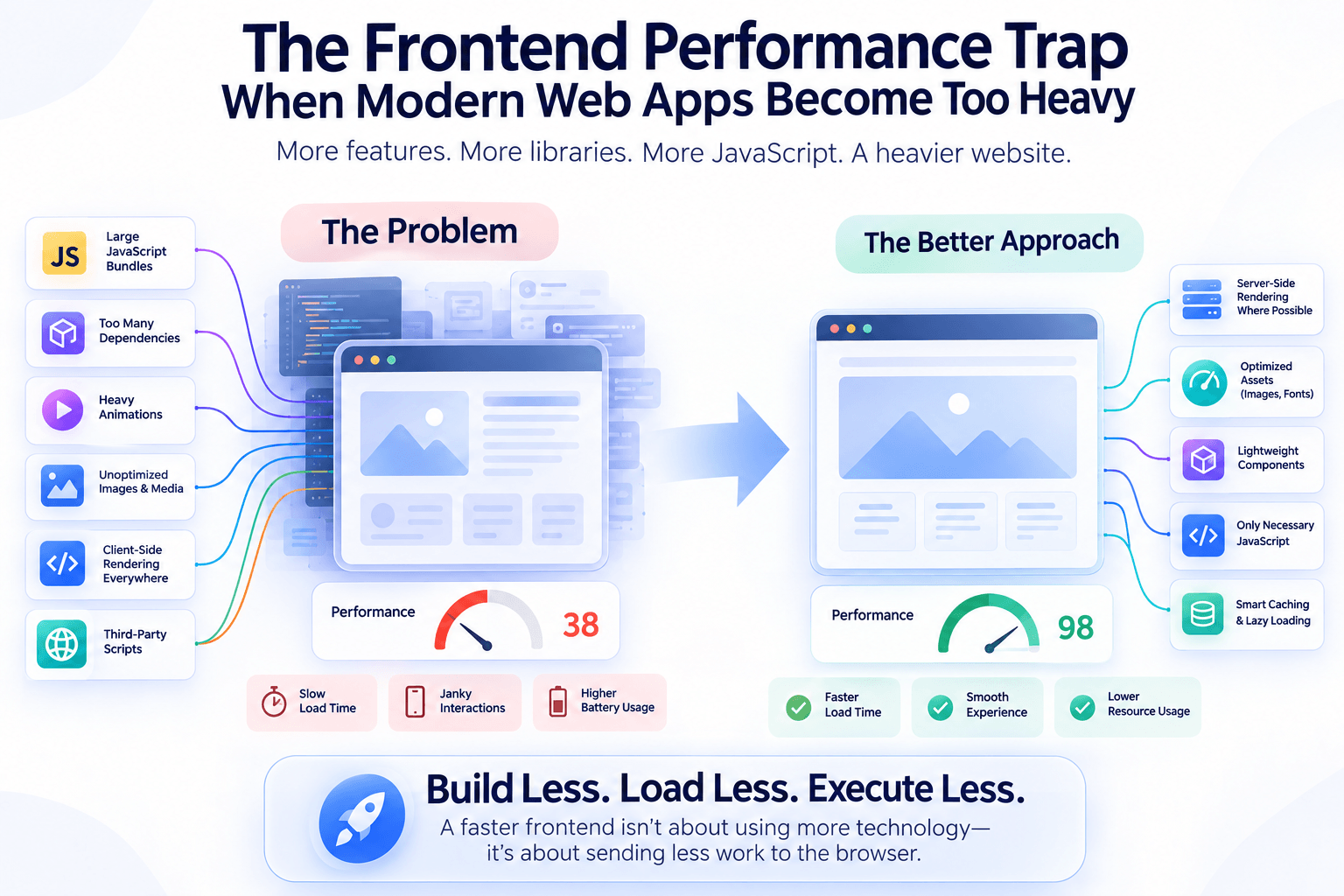
Modern web development has made it easier than ever to build powerful digital experiences. Frameworks such as React and Next.js, component libraries, animation tools, analytics platforms, third-party services, and cloud infrastructure allow developers to create applications that would have required significantly more effort a decade ago.
But there is a problem.
The same tools that make modern web applications more capable can also make them heavier.
A website can have an excellent design, a modern technology stack, reusable components, and an impressive set of features while still delivering a slow experience to users. The issue isn't necessarily that the technology is wrong. The problem is that every technology decision eventually has a cost that the browser has to pay.
Modern frontend development therefore requires a different mindset.
The goal isn't simply to build more capable applications. It is to build applications that deliver those capabilities without making the browser do unnecessary work.
Modern Doesn't Automatically Mean Fast
There is a common assumption that using a modern framework automatically results in a modern and performant website.
That isn't necessarily true.
A project can use Next.js, React, TypeScript, a modern CSS framework, optimized hosting, and a component library and still have poor performance. The framework provides tools for building performant applications, but it doesn't automatically make every architectural decision performant.
Two applications can use exactly the same framework and have completely different performance characteristics.
One might render most content efficiently on the server, load only the JavaScript required for interactive components, optimize images, and carefully control third-party scripts.
The other might send a large JavaScript bundle to the browser, render unnecessary content on the client, load multiple libraries for relatively simple interactions, and initialize features that users may never use.
The technology stack is the same.
The architecture is not.
The Browser Pays for Every Dependency
Every dependency added to a frontend project represents more than another entry in package.json.
Depending on how it is used, a dependency can increase the amount of code that needs to be downloaded, parsed, compiled, executed, and kept in memory.
This matters because the browser is not simply downloading a website and displaying it.
It has to process everything that arrives.
JavaScript is particularly expensive because downloading a script is only the beginning. The browser must parse it, compile it, execute it, and potentially keep parts of it active while the user interacts with the page.
A small dependency used for a critical feature may be completely reasonable.
The problem appears when dozens of dependencies accumulate without anyone asking whether they are actually necessary.
A library that saves a developer ten minutes can potentially add work for every visitor who loads the application.
That trade-off should be considered deliberately.
The JavaScript Trap
JavaScript has transformed what websites can do.
Modern applications can update interfaces without full page reloads, provide sophisticated interactions, communicate with APIs in real time, and create application-like experiences directly in the browser.
But JavaScript can also become one of the biggest sources of frontend complexity.
A page doesn't become better simply because it contains more client-side functionality.
Every piece of JavaScript has to be delivered to the user's device and processed by the browser. On a powerful desktop with a fast connection, the impact might be difficult to notice. On a lower-powered mobile device or slower network, the same application can feel significantly heavier.
This is why bundle size alone isn't the complete story.
Developers need to think about what the JavaScript does, when it executes, how much work it performs, and whether the user actually needs it.
The most efficient JavaScript is often the JavaScript that never reaches the browser.
When Everything Becomes Client-Side
One of the biggest architectural mistakes in modern frontend development is treating every component as if it needs to run in the browser.
Client-side rendering is extremely useful for interactive experiences. Applications often need client-side state, event handling, real-time updates, and browser APIs.
But not every piece of a page needs those capabilities.
A heading doesn't need client-side JavaScript.
A static paragraph doesn't need client-side JavaScript.
A simple article section doesn't need client-side JavaScript.
Even many visually complex components don't necessarily require large amounts of browser-side logic.
When developers move too much work to the client, the browser becomes responsible for tasks that could have been handled earlier or elsewhere.
This is one reason modern frameworks increasingly provide server-side rendering and server-oriented component models. The objective isn't to eliminate client-side JavaScript, but to use it where it provides genuine value.
Reusable Doesn't Always Mean Lightweight
Component-based development is one of the biggest improvements in modern frontend engineering.
Reusable components make applications easier to maintain and allow teams to create consistent interfaces across multiple pages and products.
But reuse can also create a false sense of efficiency.
A component may be reusable while still being unnecessarily heavy.
For example, a simple dropdown might depend on a large interaction library. A small animation might require an entire animation framework. A basic carousel might introduce a substantial JavaScript dependency when a simpler implementation would have been sufficient.
The question shouldn't only be:
"Can we reuse this component?"
It should also be:
"What does this component require the browser to do?"
Good component architecture considers both maintainability and runtime cost.
Animations Have a Performance Cost
Animations can make an interface feel polished and engaging.
They can guide attention, communicate state changes, and make interactions feel more natural.
But animation should not be confused with performance-neutral decoration.
Complex animations can require continuous browser work. Large numbers of animated elements, scroll-based effects, layout changes, or JavaScript-driven animations can increase CPU and rendering costs.
The problem becomes even more noticeable on mobile devices.
This doesn't mean animations should be removed from modern websites.
It means they should have a purpose.
A well-designed animation communicates something or improves the experience. An animation that exists simply because the technology makes it possible may not justify the performance cost.
Good frontend engineering often means knowing when not to animate.
Third-Party Scripts Are the Hidden Weight
Many websites have a performance problem that doesn't come from their own application code.
It comes from everything added around it.
Analytics platforms, advertising scripts, chat widgets, customer-support tools, social media integrations, heatmaps, consent management systems, A/B testing platforms, tracking pixels, and embedded services can collectively create a significant amount of browser work.
Each individual script may seem harmless.
The problem is accumulation.
A marketing team adds analytics. A sales team adds a chat widget. Another team adds a tracking platform. A developer embeds a social feed. A third-party service adds another dependency behind the scenes.
Eventually, the website is executing dozens of scripts that have little to do with the core experience the user came to access.
Third-party services should therefore be evaluated like any other dependency.
If a script is important, it should be justified.
If it isn't important, delaying or removing it may provide a meaningful performance improvement.
Images and Media Still Matter
Frontend performance discussions often focus heavily on JavaScript, but media remains one of the most common sources of unnecessary page weight.
High-resolution images, background videos, large hero sections, and unoptimized assets can significantly increase the amount of data a visitor needs to download.
Modern image formats, responsive images, compression, lazy loading, and appropriate sizing can reduce this cost considerably.
But optimization begins before compression.
The first question should be whether the browser needs the asset at all.
A large background image that adds little value shouldn't be treated as mandatory simply because it looks good in the design.
Performance-conscious design and performance-conscious development need to work together.
The fastest asset is often the asset that never needs to be loaded.
Performance Starts With Architecture
Performance shouldn't be treated as something developers fix after a website has been built.
By the time a project reaches the optimization stage, many performance problems may already be embedded in its architecture.
If the application requires a large client-side bundle, uses unnecessary client rendering, loads multiple libraries for simple functionality, requests too much data, or initializes every feature immediately, optimization becomes much harder.
Architectural decisions determine what the browser has to download and execute.
This means performance should be considered when deciding:
What belongs on the server
What belongs in the browser
Which components need interactivity
How data is fetched
What gets loaded immediately
What can be deferred
Which dependencies are necessary
How caching is handled
How assets are delivered
Performance is therefore not simply a Lighthouse problem.
It is an architectural problem.
Build Less, Load Less, Execute Less
A useful principle for modern frontend development is simple:
Build less. Load less. Execute less.
Building less means questioning whether every feature actually needs to exist.
Loading less means avoiding unnecessary JavaScript, images, fonts, and third-party resources.
Executing less means reducing the amount of work the browser performs after the page has loaded.
These principles sound obvious, but they are easy to forget when development is driven primarily by features.
Every new feature creates an opportunity to ask whether it can be implemented without introducing unnecessary runtime cost.
This doesn't mean sacrificing functionality.
It means treating browser resources as something valuable rather than unlimited.
Performance Is More Than a Lighthouse Score
Performance tools are extremely useful. They help developers identify problems, measure improvements, and understand how applications behave under different conditions.
But a performance score shouldn't become the entire objective.
A website can achieve a strong laboratory score while still feeling slow in certain real-world situations. Conversely, a small trade-off may sometimes be reasonable if it provides significant value to users.
The real goal is to create an experience that feels fast and responds quickly to the user's actions.
That means paying attention to metrics such as loading performance, responsiveness, layout stability, and real-user behaviour while also considering the actual experience of using the application.
Performance isn't about winning a benchmark.
It is about reducing friction.
The Best Frontend Architecture Knows What Not to Send
Modern frameworks have made sophisticated applications possible, but that doesn't mean every capability needs to reach every user's browser.
A good architecture decides what should be delivered and what shouldn't.
A product page doesn't need the entire application bundle.
A user doesn't need code for a feature they never interact with.
A server-rendered section doesn't necessarily need to become client-side simply because the application uses React.
A third-party service doesn't automatically deserve to load on every page.
These decisions may seem small individually, but they become significant at scale.
When thousands or millions of users visit an application, unnecessary browser work becomes a real infrastructure and business cost.
Performance Is a Product Decision
Frontend performance is often treated as the responsibility of developers.
In reality, it is influenced by almost every part of a digital product.
Design decisions determine how many assets need to be loaded.
Product decisions determine how many features need to exist.
Marketing decisions determine which third-party scripts are installed.
Engineering decisions determine how those features are implemented.
Content decisions determine how much information needs to be delivered.
Performance is therefore not just a technical metric.
It is a product characteristic.
A fast website doesn't happen because one developer optimized a few JavaScript files at the end of the project. It happens because the entire team understands that every feature has a cost.
Modern Web Development Requires Restraint
The most impressive frontend isn't necessarily the one using the most technologies.
A project can use every popular framework, animation library, component system, and third-party service available and still provide a worse experience than a simpler application.
Technology should solve problems.
It shouldn't become the product.
The strongest frontend developers understand not only how to implement sophisticated functionality, but also when that functionality isn't necessary.
They know when to use client-side rendering and when to keep work on the server. They know when an animation improves an interaction and when it becomes unnecessary overhead. They know when a dependency saves meaningful development time and when a few lines of code would be better.
This kind of restraint is an engineering skill.
Final Thoughts
Modern web development gives developers extraordinary capabilities. We can build applications that are more interactive, personalized, connected, and sophisticated than ever before.
But capability comes with a cost.
Every dependency, component, animation, image, third-party script, and client-side operation can add work for the browser. When those costs accumulate without architectural discipline, a modern web application can become heavier than it needs to be.
The solution isn't to abandon modern frameworks or return to simpler websites.
The solution is to use modern technology more intentionally.
Build what users need. Keep work where it belongs. Load resources when they are actually required. Avoid unnecessary dependencies. Treat the browser as a constrained environment rather than an unlimited computing platform.
The best frontend isn't the one that demonstrates how much technology a team can use.
It's the one that delivers the required experience while making the browser do as little unnecessary work as possible.
Share this article