Over the past two decades, businesses have invested billions of dollars in digital transformation. They adopted enterprise software, moved operations to the cloud, launched mobile applications, embraced automation, and more recently, began integrating artificial intelligence into their daily workflows. While these investments have accelerated innovation, they have also exposed a significant challenge. Many organisations still rely on large, monolithic systems that were never designed to adapt to today's rapidly changing business environment.
In the past, purchasing a single platform that promised to manage everything seemed like the most practical approach. A company would invest in one ERP, one CRM, one content management system, and one business application to support every department. Although these platforms offered convenience, they often became increasingly difficult to customise, integrate, and upgrade as the business evolved. What initially simplified operations eventually became a barrier to innovation.
Today's most successful organisations are taking a different approach. Instead of depending on one massive software platform, they are assembling digital ecosystems made up of specialised applications that work together seamlessly. This shift has given rise to the concept of the Composable Business, where software is treated as a collection of modular building blocks rather than a single, tightly connected system. The goal is no longer to find software that does everything. The goal is to create an ecosystem where every component performs its role exceptionally well while remaining connected to the rest of the business.
Understanding What a Composable Business Really Means
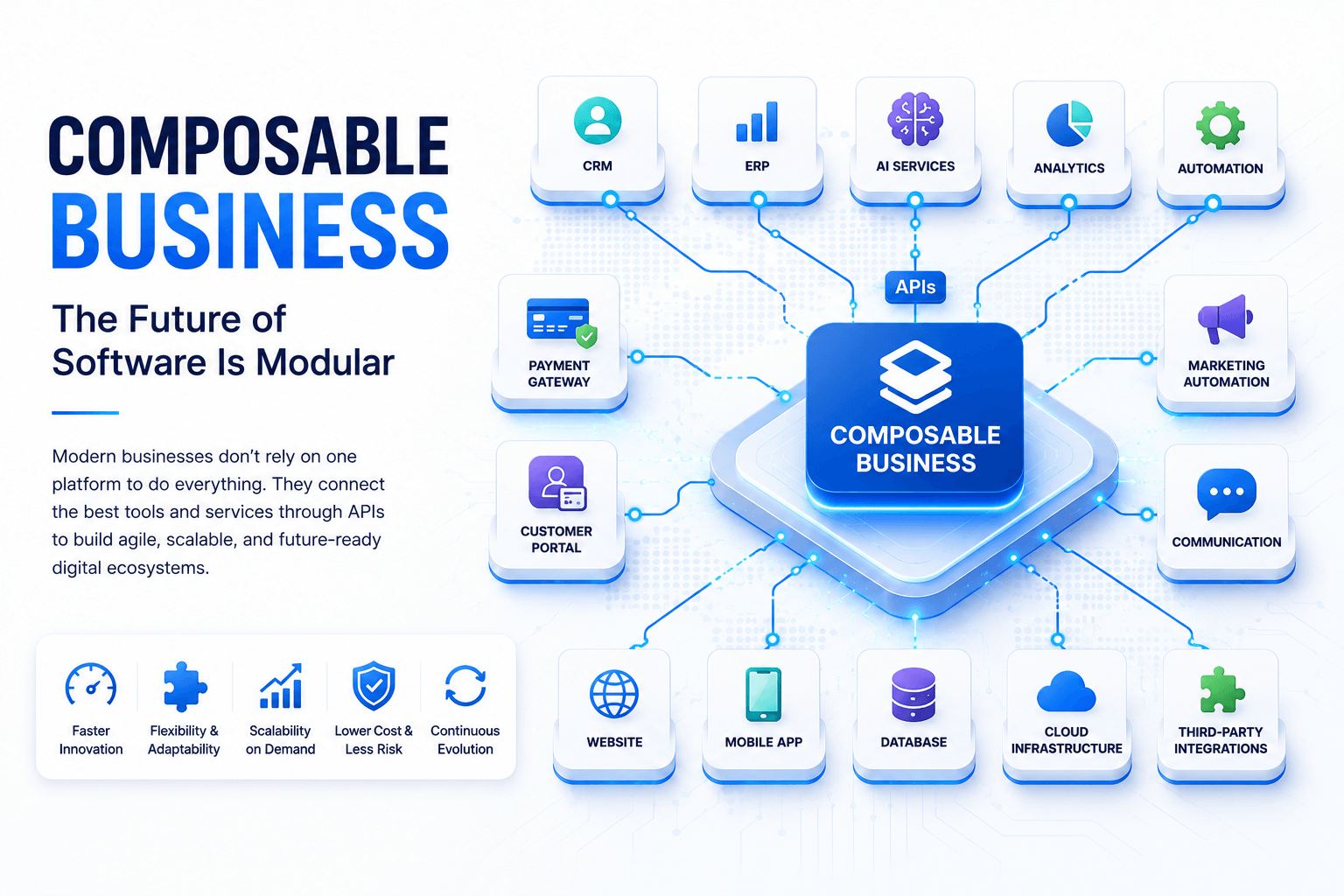
The term Composable Business may sound technical, but the idea behind it is surprisingly simple. Rather than building or purchasing one application to solve every business problem, organisations combine multiple specialised solutions that can be connected, replaced, or expanded as requirements change.
Imagine building a house using prefabricated components instead of pouring one enormous block of concrete. If you want to renovate the kitchen, you don't rebuild the entire house. You improve one section while everything else continues functioning as normal. Modern software is following the same philosophy.
A composable business treats every capability as an independent service. Customer management, payments, inventory, reporting, marketing automation, communication, and analytics all operate as individual modules that work together through APIs. This modular structure gives businesses the freedom to improve one part of their technology stack without disrupting every other system that depends on it.
The result is greater flexibility, faster innovation, and software that evolves alongside the business instead of holding it back.
Why Traditional Software Is Becoming a Limitation
Large enterprise platforms were originally designed to centralise business operations. While this approach solved many challenges during the early years of digital transformation, it also introduced new problems as technology continued evolving.
Modern businesses rarely operate within a single application. Marketing teams rely on automation platforms, finance departments use cloud accounting software, sales teams work inside CRMs, customer support depends on specialised ticketing systems, and executives expect real-time dashboards powered by data from every department.
Trying to force all these requirements into one monolithic application often creates unnecessary complexity. Even small changes can require extensive development, software upgrades become expensive, and introducing new technologies frequently involves months of planning.
Perhaps the biggest challenge is that businesses evolve much faster than traditional enterprise software. Customer expectations change, new digital channels emerge, and competitors introduce innovative services at an increasing pace. Organisations tied to rigid software platforms often struggle to respond quickly because every improvement affects the entire system.
Modularity Creates Business Agility
One of the greatest advantages of a composable business is the ability to adapt without rebuilding everything from scratch.
Suppose a company decides to replace its payment gateway with a provider that offers lower transaction fees. In a traditional architecture, this change might require modifications throughout the application. In a modular environment, the payment service can often be replaced with minimal impact on other systems because it communicates through well-defined interfaces.
The same principle applies when adding new capabilities. A business can introduce an AI assistant, launch a customer portal, connect a new CRM, integrate advanced analytics, or expand into mobile applications without redesigning its entire digital infrastructure.
This flexibility allows organisations to innovate continuously instead of waiting for large-scale redevelopment projects every few years. Technology becomes an enabler of business growth rather than a constraint.
APIs Are the Foundation of Composable Business
A modular business cannot exist without reliable communication between its components. This is where APIs become essential.
APIs allow different applications to exchange information securely and consistently, regardless of the technologies they use internally. A website can retrieve customer information from a CRM, process payments through a third-party gateway, update inventory systems, notify accounting software, and trigger marketing campaigns—all within seconds.
To customers, these interactions appear as one seamless experience. Behind the scenes, dozens of specialised services are working together through APIs.
Rather than viewing APIs as technical tools reserved for developers, businesses should recognise them as strategic assets. They create the flexibility required to introduce new technologies, automate workflows, and expand digital capabilities without disrupting existing operations.
This is one of the reasons why API-first development has become a cornerstone of modern software architecture.
Artificial Intelligence Fits Naturally Into Modular Systems
Artificial intelligence is changing how businesses operate, but its real value doesn't come from standalone chatbots or isolated AI tools. Its value comes from being able to interact with existing business systems.
An AI assistant becomes significantly more useful when it can retrieve customer information from a CRM, schedule appointments through calendar software, generate invoices using accounting systems, analyse sales reports, or automate internal workflows. None of these capabilities are possible unless the surrounding software ecosystem is designed to communicate effectively.
Composable businesses provide the ideal environment for AI because every capability is already connected through APIs. Instead of rebuilding applications to support artificial intelligence, organisations simply introduce AI as another modular service within the existing ecosystem.
This approach accelerates AI adoption while reducing implementation complexity, making intelligent automation a natural extension of the business rather than an isolated experiment.
Smaller Components Create Stronger Systems
Many organisations assume that having more applications automatically increases complexity. In reality, complexity often comes from tightly coupling everything together rather than dividing responsibilities clearly.
When software is organised into independent modules, each component has a specific purpose. Authentication manages user identities. Payment services handle financial transactions. Inventory systems manage stock. Analytics platforms generate insights. Communication services deliver notifications.
Because each module focuses on a single responsibility, development becomes more predictable. Teams can improve one service without affecting unrelated parts of the application. Testing becomes simpler, maintenance costs decrease, and new developers can understand the system more quickly.
This principle of separation not only improves software quality but also creates an environment where innovation happens faster because individual components can evolve independently.
Composable Businesses Respond Faster to Change
Business environments rarely remain stable for long. Customer behaviour shifts, regulations evolve, markets expand, and new technologies appear continuously. Organisations that struggle to adapt often find themselves spending more time maintaining legacy systems than creating new opportunities.
Composable businesses approach change differently.
Instead of asking whether their software can support a new initiative, they focus on assembling the components needed to deliver it. Launching a new digital product, integrating with a partner platform, introducing subscription billing, or deploying AI-powered customer support becomes significantly easier because the underlying architecture is designed for evolution.
This ability to respond quickly creates a genuine competitive advantage. Companies that adapt faster often outperform competitors, not because they have more software, but because their software is easier to extend.
Technology Is Becoming a Collection of Services
One of the biggest trends shaping modern software development is the move away from all-in-one platforms toward specialised cloud services. Businesses increasingly select best-in-class solutions for payments, communication, authentication, analytics, search, artificial intelligence, and automation instead of expecting one vendor to provide everything.
This shift reflects a broader change in how organisations think about technology.
Software is no longer a single product.
It has become an ecosystem of connected capabilities.
Each service contributes unique value while remaining part of a larger digital platform that supports the business as a whole.
Composable architecture makes this possible by allowing organisations to continuously improve their technology stack without replacing everything they have already built.
Building for the Future Instead of Today
One of the biggest mistakes organisations make is designing software solely around their current requirements. While this may reduce short-term development costs, it often creates expensive limitations as the business grows.
Composable businesses take a longer-term view. They recognise that customer expectations will change, new technologies will emerge, and business priorities will continue evolving. Rather than attempting to predict every future requirement, they build systems that are prepared to adapt.
This doesn't mean creating unnecessary complexity from the beginning. It means making architectural decisions that preserve flexibility, encourage integration, and allow the business to introduce new capabilities without constant redevelopment.
The organisations that succeed over the next decade will not necessarily be those with the largest technology budgets. They will be the ones whose software can evolve as quickly as their business strategy.
Final Thoughts
The future of software is no longer defined by bigger platforms or more features. It is defined by flexibility, adaptability, and the ability to connect specialised services into a unified digital ecosystem. A composable business embraces this philosophy by treating software as a collection of independent building blocks that can evolve without disrupting the entire organisation.
For businesses, this approach delivers far more than technical benefits. It reduces the cost of innovation, shortens development cycles, simplifies integrations, and creates a technology foundation that supports long-term growth. Instead of replacing entire systems whenever requirements change, organisations can continuously improve individual components while maintaining a consistent customer experience.
As digital transformation continues accelerating, modular software will become more than a technology trend—it will become a business necessity. The companies that thrive will not be those with the most software, but those with the most adaptable software ecosystems. In the years ahead, the ability to compose, connect, and evolve digital capabilities will become one of the defining characteristics of successful modern businesses.
Share this article