Every business makes decisions every single day. Some involve routine operations, while others have the potential to shape the future of the organization. Leaders decide where to invest, which markets to enter, when to hire new employees, how to improve customer experiences, and what technologies to adopt. These decisions influence profitability, operational efficiency, and long-term growth.
For many years, business decisions were largely based on experience, intuition, and personal judgment. While these qualities remain valuable, today's business environment is far more complex than it was even a decade ago. Customer expectations evolve rapidly, markets change quickly, and competition continues to increase across almost every industry. In this environment, relying solely on assumptions is becoming increasingly risky.
This is where data becomes one of a business's most valuable assets.
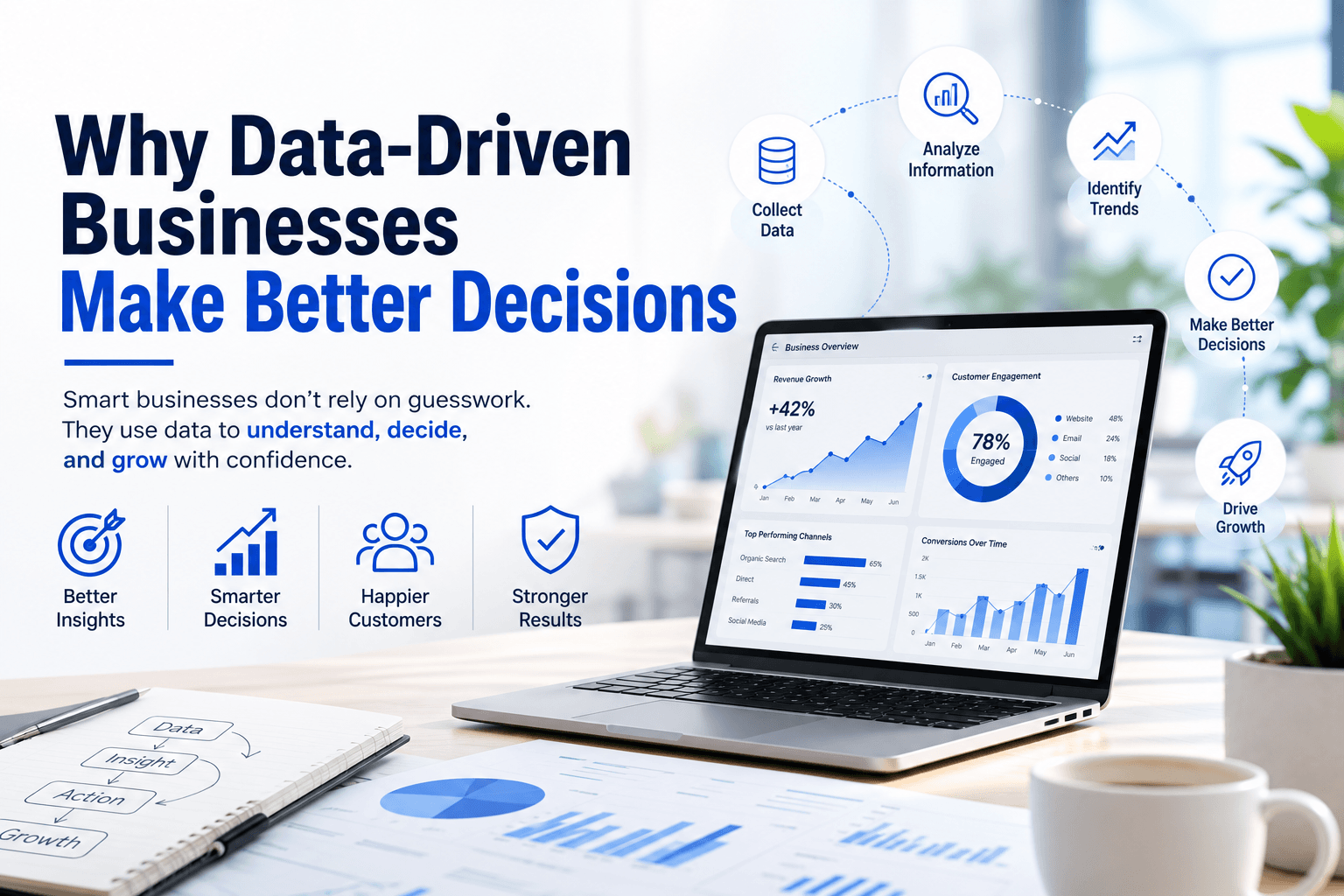
Data provides clarity where uncertainty exists. Instead of making decisions based on opinions or guesswork, organizations can understand what is actually happening within their business. They can identify trends, measure performance, understand customer behavior, and recognize opportunities for improvement long before they become obvious through intuition alone.
Being data-driven does not mean replacing human judgment with numbers. It means combining experience with reliable information to make decisions that are more informed, more strategic, and more likely to produce positive outcomes.
Assumptions Are Often More Expensive Than Businesses Realize
Every organization makes assumptions. Leaders assume customers prefer a particular service, managers believe a marketing campaign performed well, and teams often think certain internal processes are efficient because they have followed them for years.
The challenge is that assumptions are not always supported by evidence.
Imagine a company noticing that online enquiries have declined over several months. One department believes competitors are offering lower prices. Another suggests customer demand has simply decreased. Marketing argues that advertising should be increased, while sales believes the website needs improvement. Without reliable data, every opinion sounds reasonable, yet none can be confidently validated.
Now imagine the same situation with access to meaningful business data. Website analytics reveal that visitors are leaving after encountering slow-loading pages. Customer feedback indicates frustration with the enquiry process, while CRM reports show that qualified leads are declining because fewer users complete contact forms. Instead of debating opinions, the business can identify the actual problem and focus its resources on solving it.
This illustrates one of the greatest advantages of becoming data-driven. Decisions are no longer based on assumptions alone. They are supported by measurable information that helps businesses invest their time, budget, and effort where it creates the greatest impact.
Making decisions without data does not always lead to failure, but it significantly increases the likelihood of investing in the wrong priorities. Reliable information reduces uncertainty and allows organizations to move forward with greater confidence.
Good Data Creates Better Business Conversations
Healthy businesses encourage discussion, collaboration, and different perspectives when making important decisions. However, conversations become far more productive when everyone is working from the same information rather than relying on personal opinions.
Without reliable data, meetings often become debates. Different departments present conflicting viewpoints, each supported by individual experiences or isolated examples. Marketing believes customer engagement is improving, sales feels lead quality is declining, and operations focuses on internal efficiency. Although each perspective may be valid, leadership can struggle to determine which direction should guide the business.
Data changes the nature of these conversations.
Instead of asking who is correct, teams begin asking what the information is telling them. Performance metrics, customer behavior, operational reports, and financial trends provide a shared foundation for discussion. Decisions become more objective because they are based on measurable outcomes rather than assumptions or personal preferences.
This shift also improves collaboration between departments. Marketing gains a clearer understanding of sales performance, operations identifies recurring bottlenecks, and leadership develops greater visibility across the entire organization. Everyone works toward common business objectives supported by the same evidence rather than competing interpretations.
Data should never replace experience or professional judgment. Instead, it strengthens decision-making by ensuring important discussions begin with facts rather than opinions. Businesses that consistently use reliable information often resolve challenges faster because they spend less time debating the problem and more time implementing solutions.
Data Helps Businesses Understand Their Customers
Every successful business claims to put customers first, but understanding customers requires more than listening to occasional feedback or responding to individual enquiries. Customer expectations change over time, buying habits evolve, and market conditions continuously influence purchasing decisions. Businesses that rely solely on intuition often miss these changes until they begin affecting sales or customer satisfaction.
Data provides a much clearer picture of customer behaviour.
By analysing information such as website activity, purchasing patterns, customer enquiries, service requests, and feedback, businesses can identify trends that would otherwise remain hidden. They begin to understand which products generate the greatest interest, where customers abandon the buying journey, which communication channels perform best, and what factors influence long-term loyalty.
Consider an online business experiencing a steady increase in website traffic but very little growth in sales. Without meaningful data, management might assume that the product itself needs improvement or that additional marketing investment is required. However, customer behaviour reports may reveal that visitors consistently leave the website during the checkout process because it is unnecessarily complicated. Instead of increasing advertising spend, the business can improve the customer journey and achieve better results with its existing traffic.
The same principle applies across every industry. Service providers can identify the most common customer concerns, retailers can understand seasonal buying trends, and professional firms can recognise which services generate the strongest long-term relationships. Each insight helps businesses make decisions based on customer behaviour rather than assumptions.
Ultimately, businesses that understand their customers more effectively are better positioned to improve customer experiences, strengthen relationships, and create sustainable growth.
Better Data Leads to Better Investments
Every business operates with limited resources. Whether the investment involves hiring new employees, purchasing technology, expanding into new markets, or launching a marketing campaign, leaders must decide where their time and budget will create the greatest return.
These decisions become significantly easier when supported by reliable data.
Imagine a company planning to invest in digital marketing because sales have slowed during recent months. Without analysing existing business data, leadership may increase advertising spend in the hope of generating additional enquiries. However, performance reports might reveal that demand remains strong while response times have increased because the sales team is overwhelmed. In this situation, hiring an additional sales representative or improving internal processes may produce a far greater return than increasing the marketing budget.
This example demonstrates why data should influence every significant business investment. It helps organizations distinguish between symptoms and root causes, ensuring resources are directed toward the problems that genuinely require attention.
The same approach applies to technology investments. Before introducing artificial intelligence, purchasing new software, or redesigning a website, businesses should first understand what operational challenge they are trying to solve. Data provides the evidence needed to make these decisions with confidence, reducing unnecessary spending while increasing the likelihood of measurable business improvements.
Good investments are rarely driven by assumptions. They are guided by information that reflects how the business actually performs.
Technology Should Deliver Insights, Not Just Reports
Modern businesses generate enormous amounts of information every day. Customer enquiries, sales transactions, website activity, financial records, employee performance, inventory levels, and operational processes all produce valuable data. Yet collecting information alone does not make an organization data-driven.
The true value of data lies in the insights it provides.
Many businesses regularly produce reports that are reviewed once before being archived and forgotten. While these reports may contain useful information, they only become valuable when they support better decision-making. Leaders should be able to identify patterns, recognise opportunities, anticipate challenges, and respond proactively rather than simply reviewing historical performance.
Imagine a management team receiving weekly sales reports. If those reports only display revenue figures, they provide limited strategic value. However, when combined with customer trends, marketing performance, product demand, and operational metrics, they begin telling a much more meaningful story about why the business is performing the way it is and what actions should be taken next.
Technology should therefore do more than organise information. It should help businesses interpret that information in ways that support smarter decisions. Dashboards, business intelligence platforms, CRM systems, and analytics tools become valuable not because they generate reports, but because they help leaders understand what those reports mean and how they should respond.
Organizations that successfully use technology to generate meaningful insights are often able to adapt more quickly, identify opportunities earlier, and make decisions with greater confidence than businesses relying primarily on instinct.
Final Thoughts
Every business relies on decision-making, but the quality of those decisions ultimately determines the direction the organization takes. While experience, industry knowledge, and professional judgment remain essential, they become significantly more powerful when supported by accurate and reliable information.
Data does not remove uncertainty from business. Markets continue to change, customer expectations evolve, and unexpected challenges will always arise. What data provides is clarity. It allows leaders to understand their business more effectively, identify opportunities earlier, reduce unnecessary risks, and invest with greater confidence.
Becoming a data-driven business does not require collecting every possible metric or investing in complex analytical systems. It begins by identifying the information that matters most, ensuring its accuracy, and using it consistently to support everyday decisions. Over time, this approach creates a culture where decisions are based on evidence, continuous improvement becomes part of normal operations, and technology delivers measurable business value.
The businesses that succeed in the years ahead will not necessarily be those with the largest amounts of data. They will be the organizations that know how to transform information into insight and insight into action.
In today's competitive business environment, better decisions create stronger businesses, and better decisions almost always begin with better data.
Share this article