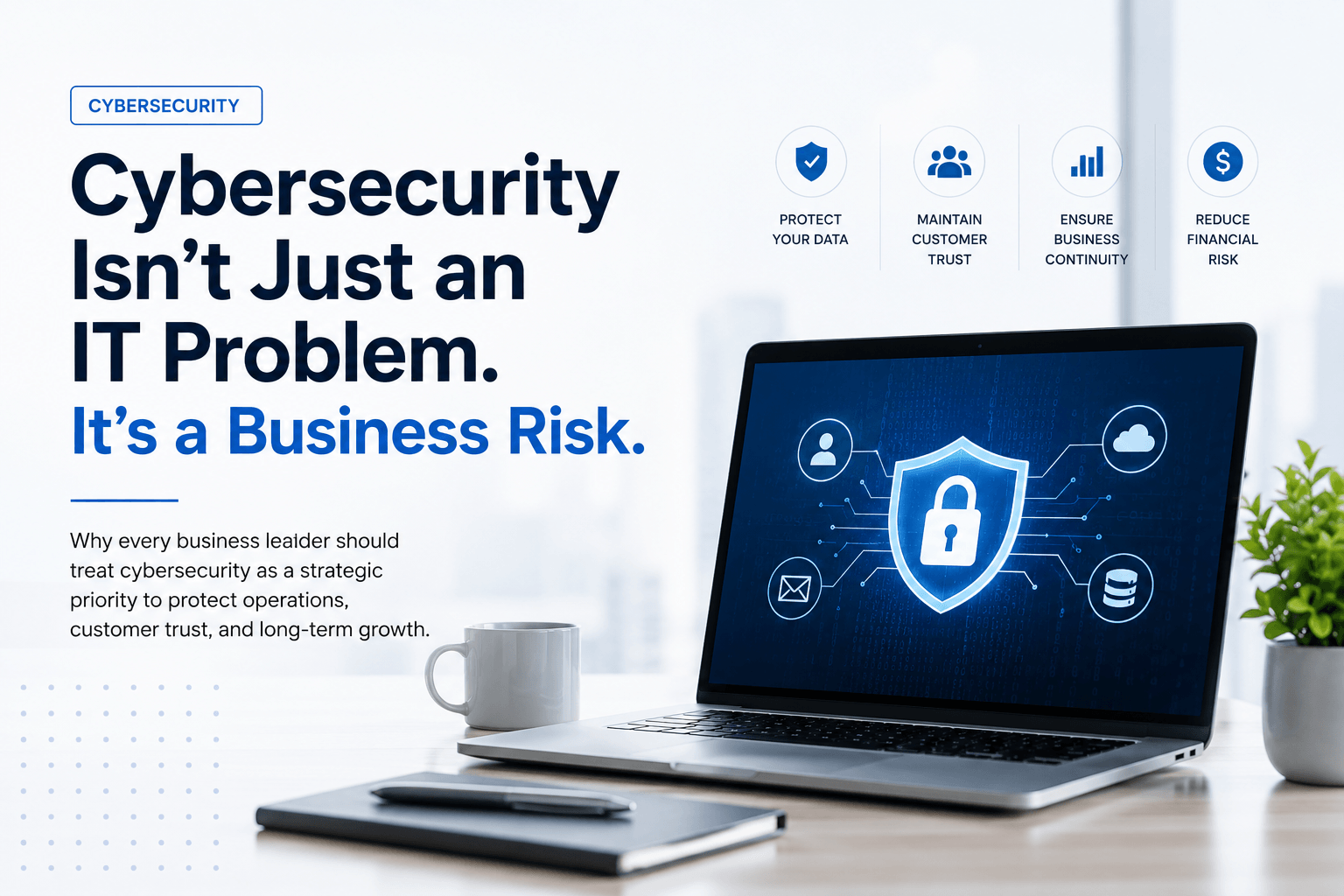
When many business leaders hear the word cybersecurity, they immediately think of firewalls, antivirus software, data encryption, or IT departments monitoring computer systems. It is often viewed as a highly technical subject that belongs exclusively to technology professionals. As long as the company's systems appear to be working normally, cybersecurity rarely becomes part of everyday business discussions.
The reality is very different.
Modern businesses rely on technology for almost every aspect of their operations. Customer information is stored digitally, financial transactions are processed online, employees collaborate through cloud platforms, and websites have become an essential channel for attracting new business. As organizations become more connected, they also become more exposed to digital threats that can affect far more than their technology infrastructure.
A cybersecurity incident is rarely just a technical problem. It can interrupt business operations, damage customer trust, delay projects, affect revenue, and create long-term reputational challenges. In many cases, the most significant consequences occur long after the technical issue has been resolved.
This is why cybersecurity should no longer be viewed as an IT responsibility alone. It is a business responsibility that deserves attention from leadership, because the decisions made at the executive level often determine how well an organization is prepared to prevent, respond to, and recover from unexpected security incidents.
Every Business Is a Potential Target
One of the most common misconceptions about cybersecurity is that cybercriminals only target large corporations. Smaller businesses often assume they have little to worry about because they do not operate at the same scale as multinational organizations or global brands.
Unfortunately, that assumption creates a false sense of security.
Many cyberattacks are not carefully planned against a single organization. Instead, attackers use automated tools that continuously scan thousands of websites, servers, and business systems looking for outdated software, weak passwords, unsecured databases, or known vulnerabilities. The size of the business often matters far less than the ease with which its systems can be accessed.
Imagine two companies operating in the same industry. One regularly updates its software, trains employees to recognize suspicious emails, and follows established security practices. The other postpones updates, uses weak passwords, and assumes cybersecurity is something to address later. If both businesses are exposed to the same automated attack, the second organization is significantly more likely to experience a security incident—not because it is more valuable, but because it presents an easier opportunity.
For business leaders, this changes the conversation completely. Cybersecurity is no longer about asking whether a business is important enough to become a target. The more relevant question is whether the organization has taken reasonable steps to reduce unnecessary risk.
The Biggest Cost Is Rarely the Technical Recovery
When businesses evaluate cybersecurity, they often focus on the immediate technical impact of an attack. They think about restoring systems, recovering files, or repairing damaged infrastructure. While these activities are important, they are often only a small part of the overall cost.
The larger impact is usually felt throughout the business itself.
Consider a company whose customer portal becomes unavailable for several days following a security incident. During that time, customers cannot access services, support requests begin to accumulate, sales opportunities are delayed, and employees spend valuable time responding to concerned clients instead of focusing on their normal responsibilities. Even after the systems are restored, the organization may continue dealing with frustrated customers who have lost confidence in the company's ability to protect their information.
Reputation is one of the most valuable assets any business possesses, and it can take years to build. Losing customer trust because of a preventable security incident can have consequences that extend well beyond the immediate financial cost of recovering systems. Clients expect businesses to protect their information, and when that expectation is not met, rebuilding confidence can be far more difficult than repairing the technology itself.
This is why cybersecurity should be viewed as an investment in business resilience rather than simply an operational expense. Protecting customer relationships, maintaining business continuity, and preserving trust are outcomes that benefit every part of the organization—not just the IT department.
Cybersecurity Is Essential for Business Continuity
Every business prepares for challenges that could interrupt normal operations. Companies invest in backup power, insurance policies, disaster recovery plans, and supply chain strategies because they understand that unexpected events can affect their ability to serve customers. Yet many organizations overlook one of the most significant risks to business continuity: cybersecurity.
A successful cyberattack can bring everyday operations to a standstill. Employees may lose access to internal systems, customer portals may become unavailable, financial transactions can be delayed, and communication between departments may be disrupted. Even businesses with talented teams and well-established processes struggle to operate effectively when the technology supporting those processes is unavailable.
Imagine a professional services company preparing to deliver an important project to one of its largest clients. On the same day, employees discover they can no longer access shared documents, project files, or internal communication systems because of a ransomware attack. Although the company's expertise remains unchanged, its ability to deliver work has been severely affected. Deadlines are missed, client confidence begins to decline, and valuable time is spent recovering operations instead of serving customers.
This illustrates why cybersecurity should never be viewed as a standalone technology initiative. It plays a direct role in protecting business continuity. Organizations that prepare for security incidents through regular backups, documented recovery procedures, and clear response plans are often able to resume operations much faster than those reacting for the first time during a crisis.
For business leaders, resilience is no longer measured only by financial strength or operational efficiency. It also depends on how quickly the organization can recover from unexpected digital disruptions while continuing to serve customers with minimal interruption.
Employees Are One of the Strongest Lines of Defence
Technology plays an important role in cybersecurity, but software alone cannot protect an organization from every threat. Many security incidents begin with ordinary business activities such as opening an email attachment, clicking a fraudulent link, sharing confidential information, or using weak passwords across multiple systems.
This means cybersecurity is as much about people and processes as it is about technology.
Employees interact with business systems every day. They communicate with customers, exchange documents with suppliers, access sensitive information, and use cloud-based platforms to perform their work. Without clear security awareness, even well-designed systems can become vulnerable through simple human mistakes.
Creating a security-conscious workplace does not require turning every employee into a cybersecurity expert. Instead, it involves building a culture where people understand the importance of protecting company information, recognising suspicious activity, and following established procedures when something appears unusual.
Business leaders play a significant role in shaping this culture. When leadership treats cybersecurity as a business priority rather than an occasional IT discussion, employees are more likely to understand its importance and incorporate secure practices into their daily routines. Over time, this shared responsibility becomes one of the organization's most valuable forms of protection.
Security Should Be Part of Every Technology Decision
Cybersecurity is often treated as something that can be added after a new website, software platform, or digital system has already been implemented. In reality, security is most effective when it is considered from the very beginning of every technology decision.
Whenever a business introduces new technology, it also creates new responsibilities. A customer portal stores personal information. A mobile application processes user data. Cloud platforms provide remote access to business resources. Artificial intelligence tools may interact with confidential documents or internal knowledge. Every digital solution introduces opportunities for growth, but it also introduces new risks that should be carefully evaluated.
For this reason, business leaders should include security in the same conversations as functionality, cost, scalability, and user experience. Questions such as How will customer data be protected?, Who will have access to sensitive information?, and How will security updates be managed over time? are just as important as discussing features or implementation timelines.
Considering security during the planning stage is often far more effective than trying to resolve vulnerabilities after systems have already gone live. It reduces long-term costs, minimizes operational risk, and provides greater confidence that new technology will support the business safely as it grows.
Organizations that consistently make better technology decisions rarely treat cybersecurity as a final checklist item. Instead, they view it as a fundamental requirement that supports every digital initiative they undertake.
Final Thoughts
Cybersecurity has evolved far beyond protecting computers and networks. It now protects customer trust, business continuity, operational resilience, and the reputation organizations work hard to build over many years. Every digital system a business relies on—from its website and customer database to its internal software and cloud platforms—plays a role in supporting everyday operations. Protecting those systems means protecting the business itself.
The organizations that manage cybersecurity most effectively are not necessarily those with the largest technology budgets or the most advanced security tools. They are the businesses that recognise cybersecurity as a leadership responsibility, build secure processes from the beginning, encourage employee awareness, and make informed technology decisions with long-term resilience in mind.
No business can eliminate every risk, but every business can reduce unnecessary exposure by making cybersecurity part of its overall business strategy rather than treating it as a purely technical concern.
In today's digital economy, cybersecurity is no longer just an IT problem.
It is a business responsibility, and one of the most important investments an organization can make in protecting its future.
Share this article