Technology has become one of the largest areas of investment for modern businesses. Whether it's a new CRM, an AI-powered platform, custom software, or a complete website redesign, organizations are constantly evaluating tools that promise to improve productivity, reduce costs, and support future growth.
Having access to more technology should make these decisions easier. In many ways, it has done the opposite.
Business leaders are now faced with thousands of software platforms, each claiming to be faster, smarter, or more innovative than the last. Product demonstrations are impressive, feature lists are extensive, and every solution promises to solve operational challenges. Yet despite these promises, many technology investments fail to deliver the expected results.
The reason is rarely the software itself.
More often, businesses invest in technology before they fully understand the problem they're trying to solve. Decisions become influenced by urgency, competitor activity, or attractive feature lists instead of long-term business objectives. As a result, companies often introduce new systems that employees struggle to adopt, customers never notice, or leadership eventually replaces after only a few years.
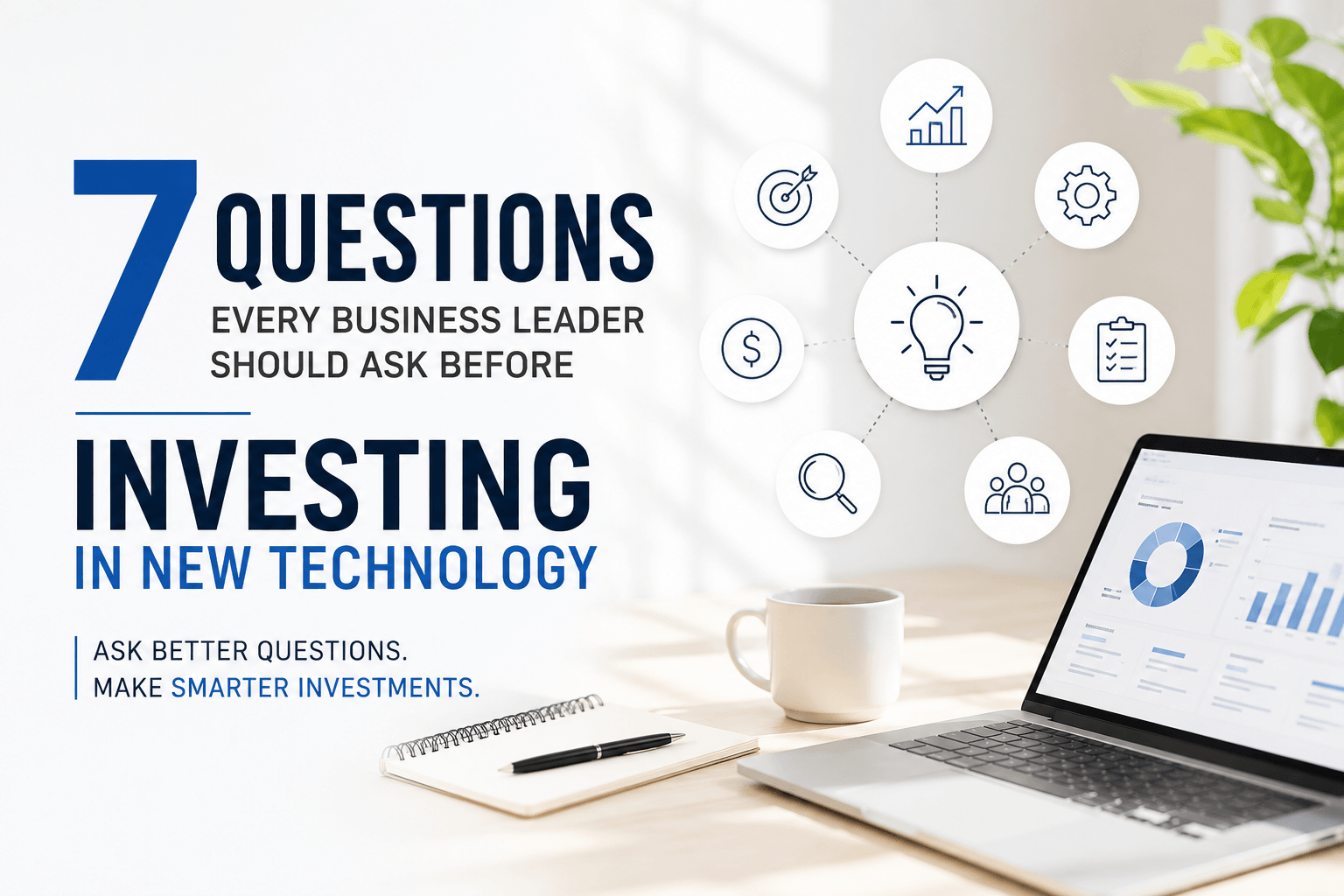
Successful technology investments begin long before a contract is signed. They begin with asking better questions.
Before committing time, money, and resources to another technology project, every business leader should take a step back and evaluate whether the investment truly supports the organization's long-term goals.
1. What Business Problem Are We Actually Trying to Solve?
Every technology investment should begin with a clearly defined business problem rather than a preferred solution.
This may sound obvious, yet many organizations approach technology from the opposite direction. They decide they need artificial intelligence, a new CRM, or custom software before identifying the operational challenge they expect it to address. The conversation quickly becomes focused on products and features instead of the underlying business issue.
Imagine a sales team complaining that customer follow-ups are inconsistent. The immediate reaction might be to purchase a more advanced CRM platform. However, after further investigation, leadership discovers that the real issue isn't the software at all. Sales representatives are following different processes, customer information is incomplete, and no standardized follow-up procedure exists.
Replacing the CRM won't solve those problems.
Understanding the problem first allows businesses to evaluate whether technology is genuinely required or whether improvements to existing processes would deliver the same outcome. In many cases, the most successful technology investments aren't those with the longest feature lists—they're the ones that solve a clearly defined operational challenge.
2. Will This Technology Still Support Our Business Three Years From Now?
Businesses rarely remain the same for very long.
New services are introduced, teams expand, customer expectations evolve, and operational requirements become more complex. Technology that perfectly supports today's business may struggle to meet tomorrow's demands if scalability wasn't considered from the beginning.
This is particularly important when evaluating core business systems. A platform that works well for a team of ten employees may become increasingly difficult to manage once the organization grows to fifty or one hundred people. Likewise, software that cannot integrate with future systems or accommodate new workflows often forces businesses into expensive upgrades much sooner than expected.
Instead of asking whether a solution meets today's requirements, business leaders should consider how it will support future growth. Will it handle increased demand? Can additional functionality be introduced without major redevelopment? Will it continue supporting the business as new departments, products, or markets are added?
Thinking beyond immediate requirements often leads to better long-term decisions and reduces the likelihood of replacing important systems after only a few years.
3. Will Employees Actually Use It?
One of the most overlooked factors in any technology investment is user adoption.
A platform may offer hundreds of advanced features, powerful reporting capabilities, and impressive automation tools, but none of those benefits matter if employees avoid using the system or only rely on a small fraction of its functionality.
Technology succeeds when it becomes part of everyday work rather than an obstacle employees must learn to navigate. If software feels unnecessarily complicated, requires excessive training, or introduces more steps into existing workflows, adoption naturally declines. Teams often return to spreadsheets, emails, or manual processes because those methods feel more familiar and efficient.
Consider two businesses investing in project management software. One chooses a platform because it offers every feature imaginable. The other selects a solution that aligns closely with the way its teams already work. Six months later, the second business is likely to see stronger adoption because the technology complements existing workflows instead of forcing employees to change everything about the way they operate.
Successful technology isn't measured by how many features it includes.
It's measured by how naturally people incorporate it into their daily work.
4. Can It Integrate With Our Existing Systems?
Very few businesses operate using a single piece of software.
Customer information may exist inside a CRM, financial records are managed through accounting software, marketing campaigns rely on separate platforms, and operational data is often stored in additional business systems. Each platform plays an important role, but the real value comes from how well those systems work together.
When technology operates in isolation, employees often find themselves repeating the same work across multiple applications. Customer information is entered more than once, reports require manual compilation, and important data becomes inconsistent because different departments rely on different sources.
Before investing in any new technology, it's worth asking how it will fit within the existing technology ecosystem. Can it exchange information with current systems? Will it reduce manual work rather than increase it? Can data move automatically between departments without constant employee involvement?
Businesses rarely benefit from adding more disconnected software.
They benefit from creating connected systems that allow information to move efficiently throughout the organization.
5. What Will It Cost Beyond the Initial Purchase?
When businesses evaluate a new technology investment, the first number they usually compare is the purchase price. While the initial cost is important, it rarely represents the total investment required to make a new system successful.
Every technology project comes with additional considerations that aren't always obvious during the purchasing process. Employees need time to learn new software, existing data may need to be migrated, workflows often require adjustment, and teams usually experience a temporary drop in productivity while adapting to new processes. Depending on the complexity of the solution, businesses may also need ongoing maintenance, software updates, technical support, or additional integrations in the future.
These costs shouldn't discourage businesses from investing in technology. Instead, they should encourage better planning. A solution that appears less expensive at the beginning may ultimately require more time, support, and redevelopment than a higher-quality platform that was designed with long-term stability in mind.
Before approving any technology investment, business leaders should look beyond the purchase price and evaluate the total cost of ownership. Understanding what happens after implementation provides a much more realistic picture of the investment and helps avoid unexpected expenses later.
6. Are We Investing in Features or Business Outcomes?
Modern software platforms compete by offering increasingly impressive feature lists. Artificial intelligence, advanced reporting, workflow automation, predictive analytics, custom dashboards, and countless other capabilities often become the focus of product demonstrations.
While these features can certainly provide value, they should never become the reason a business invests in technology.
The real objective isn't to purchase software with the longest list of capabilities. It's to improve the way the business operates.
Imagine two organisations evaluating the same platform. One is impressed by the number of features it offers and decides to purchase it immediately. The other spends time identifying the outcomes it hopes to achieve before making a decision. It wants to reduce customer response times, improve collaboration between departments, eliminate repetitive administrative work, and provide management with more reliable reporting.
Although both businesses purchase similar technology, the second organisation is much more likely to succeed because it measures the investment against meaningful business objectives rather than software capabilities.
Business leaders should always ask themselves a simple question before approving any technology investment:
"What measurable improvement are we expecting this technology to create?"
When the answer focuses on business outcomes instead of technical features, technology decisions become significantly easier to evaluate.
7. How Will We Measure Success?
Technology investments often fail because businesses never define what success actually looks like.
Once implementation is complete, teams move on to other priorities without reviewing whether the original objectives have been achieved. Months later, leadership may still be unsure whether the investment delivered meaningful value because no clear measurements were established from the beginning.
Success should never be based solely on whether the software was installed successfully.
Instead, businesses should identify measurable indicators that reflect real operational improvements.
Has customer response time improved?
Are employees spending less time on repetitive administrative work?
Has reporting become faster and more accurate?
Have manual errors been reduced?
Is collaboration between departments more efficient?
These types of outcomes provide a much clearer understanding of whether a technology investment is delivering value.
Establishing measurable objectives also creates accountability throughout the project. Leadership, technology partners, and internal teams all understand what the organisation is trying to achieve, making it easier to evaluate progress and identify opportunities for further improvement.
Technology should always support business performance.
If success cannot be measured, it becomes difficult to determine whether the investment has genuinely improved the organisation.
Final Thoughts
Technology has become one of the most important investments a modern business can make, but successful investments are rarely defined by the software itself. They are defined by the decisions that are made long before implementation begins.
Businesses that consistently achieve positive outcomes don't simply purchase the latest platforms or follow industry trends. They take time to understand their operational challenges, involve the right people in the decision-making process, and evaluate technology based on the long-term value it can create rather than the excitement surrounding new features.
Every technology investment should ultimately answer one important question:
"Will this help our business operate more effectively?"
If the answer is supported by clear objectives, measurable outcomes, and a well-defined strategy, the investment is far more likely to deliver lasting value.
Technology will continue to evolve, and new opportunities will always emerge. The businesses that benefit the most won't necessarily be those investing in the newest tools. They'll be the organisations asking the right questions before making every technology decision.
Share this article