Artificial intelligence has become remarkably accessible. A company can connect an application to a large language model, build a chat interface, and have an AI-powered prototype running in a relatively short amount of time. This accessibility has opened the door to thousands of new AI products and features across almost every industry.
But getting a model to produce an impressive response is not the same as building a reliable AI product.
A model can generate text, analyse information, write code, summarize documents, or answer questions. What it cannot do on its own is understand a company's private data, securely access business systems, remember relevant information, follow organizational rules, evaluate its own output, or reliably complete a complex workflow.
That is where the real engineering begins.
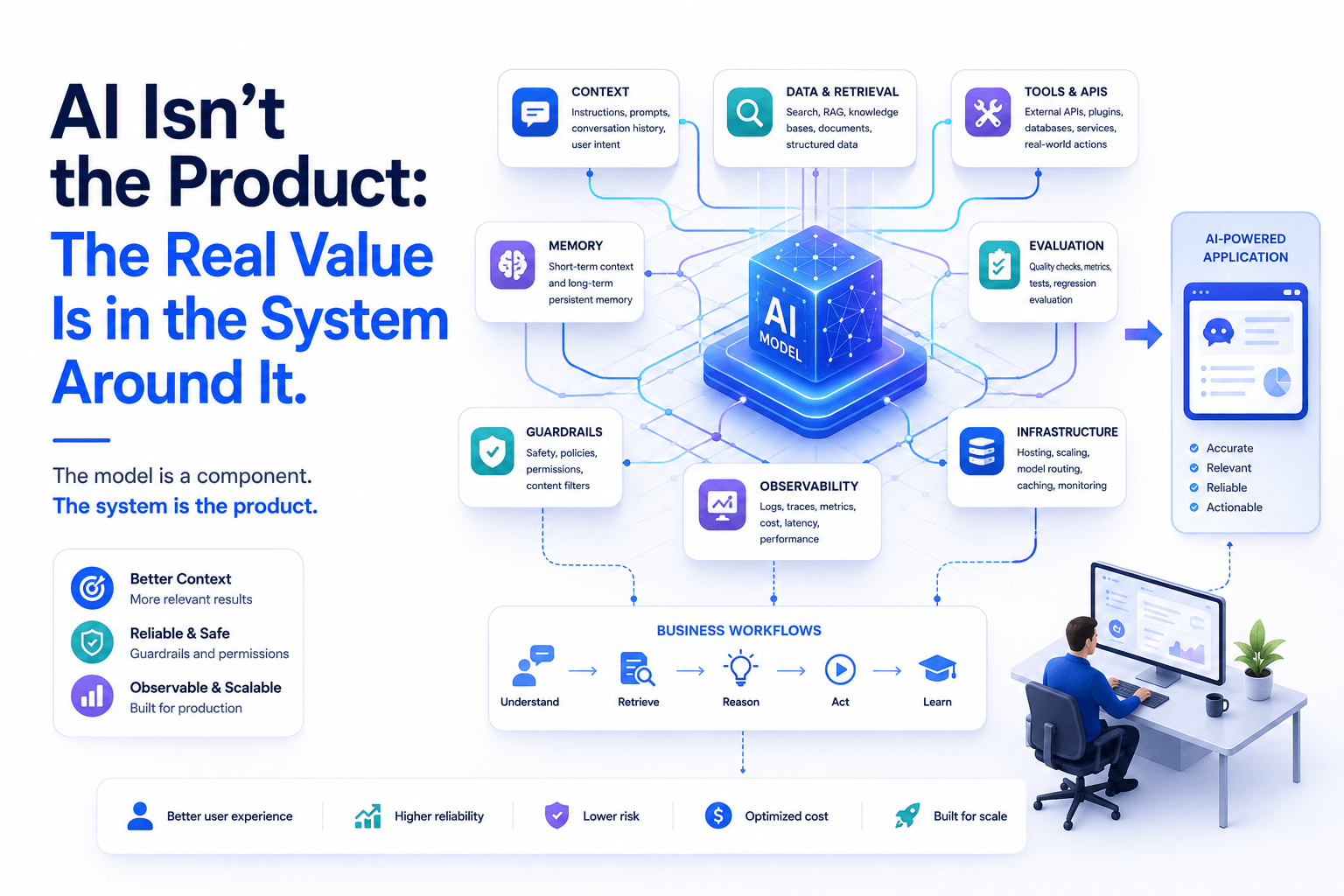
The model is only one component of the overall system. The value of a production AI application increasingly comes from everything built around that model: context, data, retrieval, tools, memory, evaluation, security, observability, infrastructure, and the workflows that connect all of these pieces together.
The model is a component. The system is the product.
The Model Is Only One Layer
When companies begin an AI project, one of the first questions is often: Which model should we use?
That question matters, but it is only one part of the architecture.
Two companies can use the same underlying model and build completely different products. One may produce unreliable answers because it provides poor context and has no evaluation process. The other may deliver a highly useful experience because it has strong retrieval, carefully designed workflows, appropriate tools, and robust validation.
The model provides intelligence, but the surrounding system determines how that intelligence is applied.
This is similar to traditional software development. Choosing a programming language doesn't determine whether an application will be well designed. The architecture, data model, APIs, security, testing, and user experience all contribute to the final product.
AI is no different.
The model may be powerful, but power without a well-designed system doesn't automatically create value.
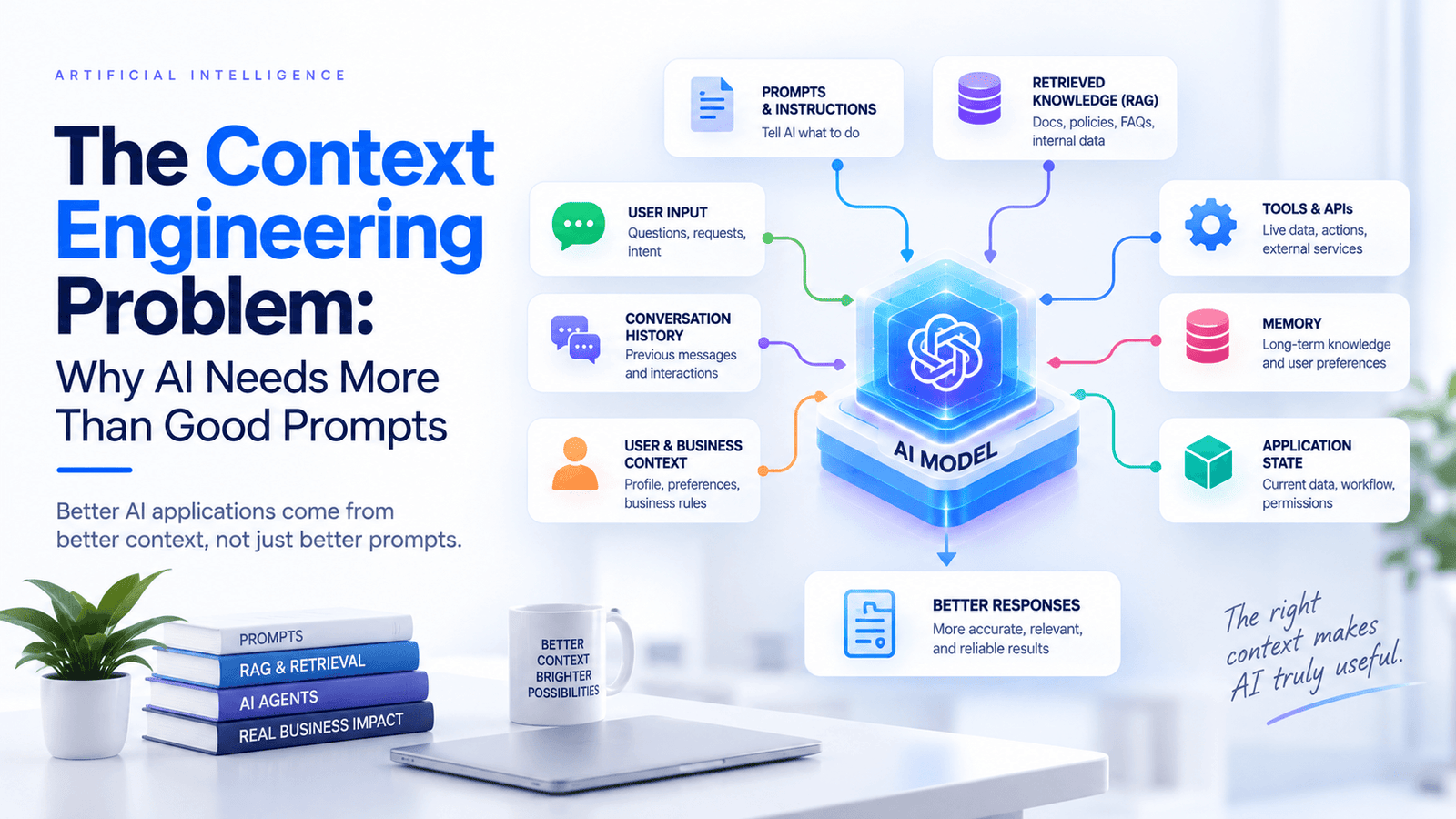
Context Is What Makes AI Useful
A general-purpose model knows a great deal, but it doesn't automatically know everything about the environment in which a business operates.
A company's internal policies, customer records, product catalogue, technical documentation, contracts, procedures, and operational data may not be part of the model's knowledge.
This is where context becomes critical.
An AI system needs the right information at the right time to produce useful results. Retrieval-augmented generation, search systems, databases, document retrieval, and context management can provide that information when it is needed.
Consider a customer-support assistant.
A generic model might know how to answer common questions about a product category. But a useful support system needs to know the company's actual policies, the customer's account information, current product status, previous interactions, and potentially the latest information from internal systems.
The difference isn't necessarily the intelligence of the model.
It's the quality and relevance of the context surrounding it.
More Context Doesn't Always Mean Better AI
There is another important problem: simply giving an AI system more information doesn't guarantee better results.
Large amounts of irrelevant context can make it harder for a model to identify what actually matters. It can increase processing costs, increase latency, and potentially introduce conflicting information.
Production AI systems therefore need to think carefully about context selection.
If a knowledge base contains thousands of documents, the system shouldn't necessarily send all of them to the model for every request.
It should identify the information most relevant to the current task.
This is where retrieval strategies, ranking, metadata, filtering, chunking, and relevance scoring become important.
Good AI architecture isn't about giving the model everything.
It's about giving it the right information at the right time.
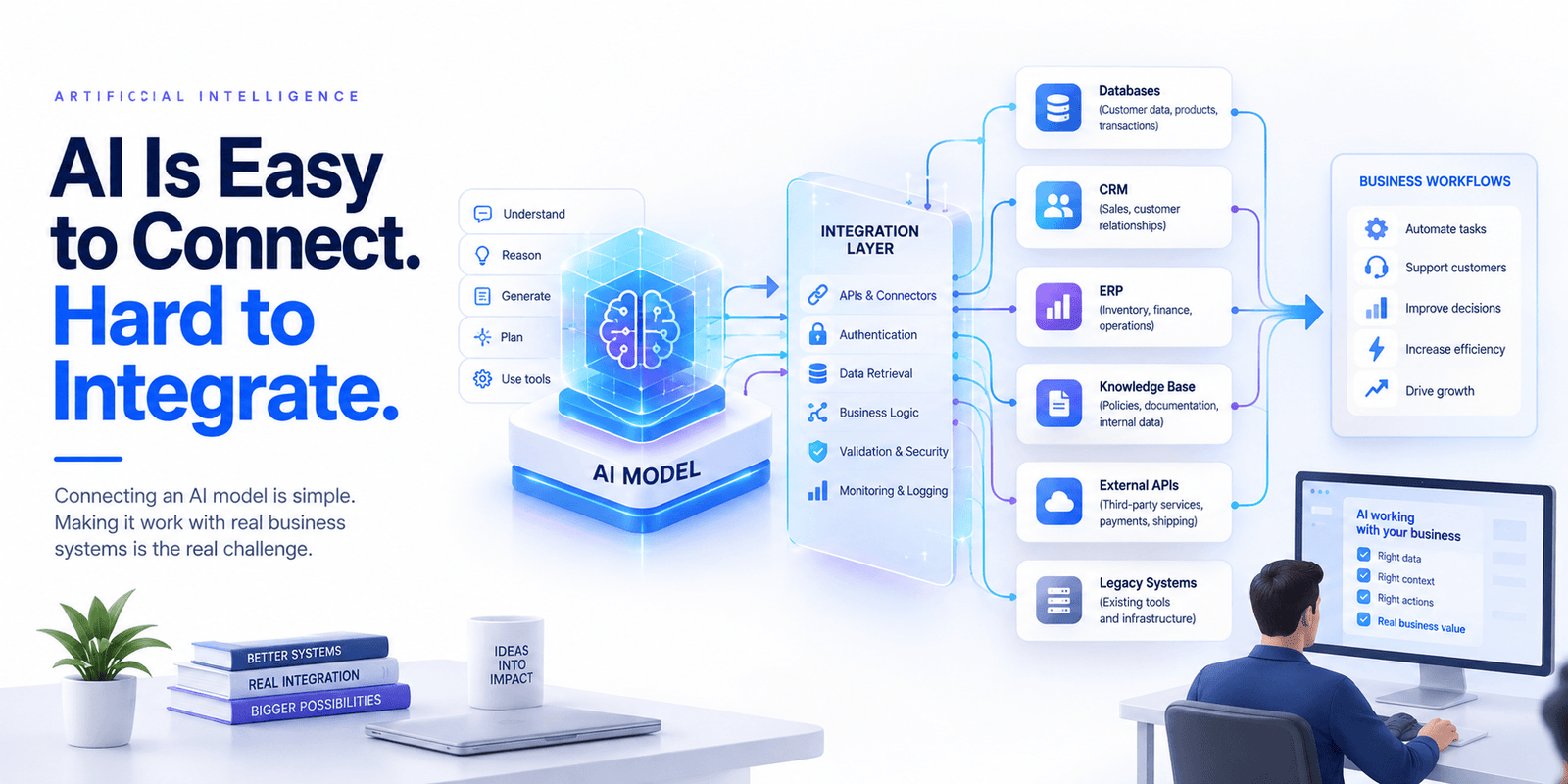
Tools Turn AI Into a System
A language model can generate an answer, but business applications often need AI to do something beyond generating text.
An AI assistant might need to search a database, retrieve an order, check inventory, create a ticket, send an email, schedule an appointment, calculate a value, or call an external API.
This is where tools become important.
Tool calling allows an AI system to interact with external capabilities instead of operating entirely within the model.
The model determines what action may be required, while the surrounding application controls how that action is actually performed.
This distinction is important.
The AI shouldn't necessarily be given unrestricted access to every system in the company. Instead, it should be provided with clearly defined capabilities and appropriate permissions.
For example, an AI customer-support system might have access to tools such as:
Search customer → Retrieve order → Check delivery status → Create support ticket
Each capability can have its own validation and authorization rules.
This creates a much safer and more controllable architecture than allowing the model to interact with everything directly.
AI Agents Need Boundaries
As AI systems become capable of using multiple tools and completing multi-step tasks, they begin to resemble autonomous agents.
An agent may interpret a goal, decide what actions are required, call several tools, evaluate intermediate results, and continue until the task is completed.
This creates enormous possibilities.
It also introduces significant risks.
The more actions an AI system can perform, the more important permissions and boundaries become.
An agent that can read information is different from one that can modify information. An agent that can create a draft is different from one that can send it. An agent that can recommend a purchase is different from one that can complete the transaction.
AI systems should therefore have clearly defined capabilities.
A useful principle is:
Give the AI the minimum access required to accomplish the task.
This reduces the potential impact of mistakes and makes the system easier to reason about.
Memory Gives AI Continuity
Traditional chat interactions often treat each conversation as a temporary context.
But many useful AI applications require some form of memory.
A personal assistant may need to remember user preferences. A customer-support system may need access to previous interactions. An internal AI tool may need to understand the history of a project.
Memory can make AI applications significantly more useful, but it introduces another architectural challenge.
Not everything should be remembered.
Some information becomes outdated. Some information is irrelevant. Some information should never be retained. And some information may need to be forgotten or updated when circumstances change.
This means memory needs its own design principles.
The system needs to determine what should be stored, how important it is, how long it should remain available, and when it should be retrieved.
Memory isn't simply a bigger context window.
It is a data-management problem.
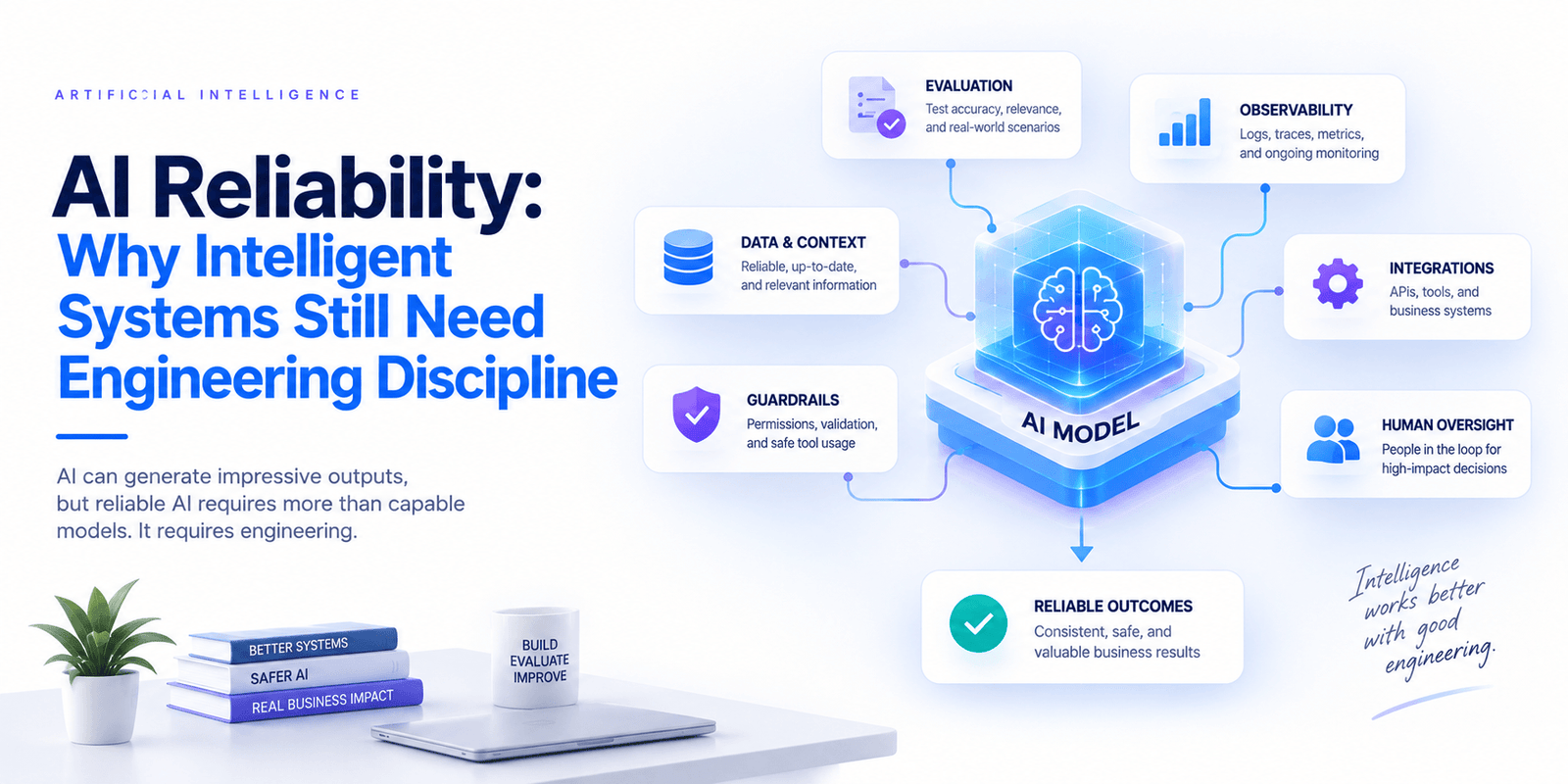
Evaluation Is the Missing Layer
One of the easiest mistakes in AI development is evaluating a system based on a few impressive examples.
A developer asks the AI several questions, receives good responses, and concludes that the system works.
Production environments are different.
Real users ask unexpected questions. Data changes. Documents become outdated. APIs fail. Models behave differently with different inputs. Small changes to prompts or retrieval strategies can improve one scenario while breaking another.
This makes evaluation essential.
A production AI system needs a way to measure whether its outputs are actually improving.
Depending on the application, teams may evaluate:
Accuracy
Relevance
Factual consistency
Retrieval quality
Tool selection
Task completion
Response quality
Safety
Latency
Cost
Evaluation transforms AI development from subjective experimentation into an engineering discipline.
Instead of asking:
"Does the AI seem good?"
teams can ask:
"How does this version perform against defined expectations?"
Guardrails Make AI More Reliable
AI systems are probabilistic.
Traditional software generally follows explicitly defined logic. AI models can interpret the same instruction differently depending on context and input.
That flexibility is powerful, but it also creates uncertainty.
Guardrails help reduce that uncertainty.
They can enforce rules around what the system is allowed to generate, which tools it can use, what information it can access, and when human approval is required.
For example, an AI assistant may be allowed to prepare a refund but not execute it without confirmation. It may be allowed to retrieve customer information but not expose sensitive fields. It may be able to draft an email but require a human to approve the final message.
Guardrails don't eliminate AI errors.
They create boundaries around the consequences of those errors.
That distinction is critical when AI moves from generating information to taking actions.
Observability Becomes Essential in AI Systems
Traditional applications are monitored for errors, latency, traffic, database performance, and infrastructure health.
AI applications require additional visibility.
A production team may need to understand which model was used, how much context was retrieved, which tools were called, how long each step took, how many tokens were consumed, where failures occurred, and whether the final result satisfied the task.
Without this information, debugging an AI system can become extremely difficult.
Imagine an AI assistant suddenly producing poor answers.
Is the model having a problem?
Did the retrieval system return irrelevant documents?
Did the context contain conflicting information?
Did a tool return incorrect data?
Did a prompt change?
Did the system exceed a context limit?
Did latency cause a fallback model to be used?
Observability allows teams to answer these questions.
AI systems need to be observable not just at the infrastructure level, but across the entire reasoning and execution workflow.
Latency and Cost Are Part of the Architecture
An AI feature that takes ten seconds to respond may be impressive technically but frustrating for users.
An AI workflow that makes dozens of model and tool calls may also become prohibitively expensive at scale.
This means latency and cost need to be considered from the beginning.
Teams may use techniques such as caching, smaller models for simpler tasks, model routing, context optimization, batching, asynchronous processing, and efficient retrieval to control these costs.
Not every request requires the most powerful model.
A simple classification task doesn't necessarily need the same model used for complex reasoning. A frequently requested response may not need to be generated from scratch every time.
Good AI architecture treats model calls as an engineering resource.
The question isn't simply:
"Can the model do this?"
It is also:
"Can the system do this reliably, quickly, and economically at scale?"
The Workflow Matters More Than the Chat Interface
Many AI products begin with a chatbot.
A user types something.
The AI responds.
This can be useful, but a conversational interface alone doesn't necessarily create meaningful business value.
The real opportunity often appears when AI becomes part of an existing workflow.
Instead of simply answering a support question, the system can retrieve the customer's account, identify the relevant issue, check an order, create a ticket, and prepare a response.
Instead of simply generating a sales report, AI can retrieve the relevant data, analyse trends, identify anomalies, and produce actionable recommendations.
Instead of simply summarizing a document, it can extract important information, compare it against internal policies, and route the result to the appropriate team.
The interface is only the entry point.
The workflow is where the value is created.
AI Products Are Systems of Systems
A production AI application rarely consists of just an application and an LLM.
It may contain:
User Interface
Where people interact with the product.
AI Model
The reasoning and generation layer.
Context and Retrieval
The information provided to the model.
Tools and APIs
The capabilities available to the AI.
Memory
The information retained across interactions.
Guardrails
The policies and restrictions surrounding AI behaviour.
Evaluation
The mechanisms used to measure quality.
Observability
The infrastructure used to understand system behaviour.
Data and Infrastructure
The underlying systems that support the entire application.
These components work together.
If one layer is weak, the overall experience can suffer.
A powerful model cannot compensate for terrible retrieval. Excellent retrieval cannot compensate for broken tools. Good tools cannot compensate for poor permissions.
AI quality is therefore often a system-level property.
The Real Competitive Advantage Is the System
As access to powerful models becomes increasingly widespread, the model itself can become less of a differentiator.
If competitors can access similar models, simply using the same model doesn't create a sustainable advantage.
The differentiation can instead come from the system surrounding it.
A company may have better proprietary data, better retrieval, stronger workflows, deeper integrations, better evaluation, more reliable tools, lower latency, or a more effective user experience.
This creates an interesting shift in AI product development.
The question is no longer simply:
"Which model are you using?"
It becomes:
"What have you built around the model?"
That is where much of the engineering value exists.
Building AI for Production
Building a prototype and building a production AI system are two very different challenges.
A prototype demonstrates that something is possible.
A production system needs to demonstrate that it can be trusted.
It needs reliable data, appropriate context, controlled tools, predictable workflows, strong evaluation, security, observability, manageable costs, and a clear failure strategy.
The model remains important, but it is only one part of the equation.
The strongest AI teams therefore don't think about AI as simply adding an LLM to an existing product.
They think in terms of systems.
They ask what information the AI needs, what actions it should perform, what it should remember, what it should never do, how its output will be evaluated, how failures will be detected, and how the entire workflow will behave under real-world conditions.
That mindset separates an AI demo from an AI product.
Final Thoughts
The rapid progress of AI models has made intelligence easier to access. But access to intelligence isn't the same as creating useful software.
The real value comes from connecting that intelligence to the right context, data, tools, workflows, memory, evaluation systems, guardrails, and infrastructure.
A model can generate an answer.
A system can understand a situation, retrieve the right information, take an appropriate action, verify the result, handle failure, and deliver meaningful value to the user.
That distinction will become increasingly important as AI moves from simple assistants toward systems that participate directly in business operations.
The companies that build the strongest AI products won't necessarily be the ones with access to the biggest model.
They'll be the ones that build the best systems around the model.
The model is a component. The system is the product.
Share this article