Artificial intelligence is everywhere right now.
Every week, there seems to be a new AI tool, a new AI startup, or a new claim about how AI is transforming the way businesses operate. One of the most talked-about developments is the rise of AI agents. From handling customer conversations to completing tasks across multiple systems, AI agents are quickly becoming one of the hottest topics in business technology.
At the same time, traditional automation continues to power countless business processes behind the scenes. Automated workflows send emails, update CRMs, generate reports, and move information between systems without requiring human intervention.
This has left many business owners asking an important question:
Should we invest in AI agents or stick with traditional automation?
The answer isn't as straightforward as choosing one over the other. To make the right decision, it's important to understand what each approach does, where it works best, and how it can support your business goals.
What Is Traditional Automation?
Traditional automation follows predefined rules and workflows.
A specific action triggers a predefined response.
For example:
A customer submits a contact form.
The information is added to a CRM.
A confirmation email is sent.
A task is assigned to the sales team.
The process is predictable because every step has been defined in advance.
Businesses have been using this type of automation for years to reduce repetitive work and improve efficiency. Modern platforms such as n8n, Power Automate, Zapier, and custom integrations make it possible to automate hundreds of business processes without requiring constant human involvement.
The biggest advantage of traditional automation is reliability. Once a workflow is configured correctly, it performs the same task consistently every time.
What Is an AI Agent?
An AI agent goes beyond following predefined instructions.
Instead of simply executing a fixed workflow, an AI agent can understand context, analyze information, make decisions, and adapt its responses based on the situation.
For example, an AI agent handling customer enquiries can:
Understand natural language questions.
Provide relevant answers.
Ask follow-up questions.
Gather project requirements.
Recommend services.
Create summaries for internal teams.
Unlike traditional automation, the response is not always identical. The AI evaluates the situation and generates an appropriate outcome based on the information available.
This flexibility is what makes AI agents so powerful.
The Key Difference
The easiest way to understand the difference is this:
Traditional automation follows instructions.
AI agents make decisions within defined boundaries.
If a workflow always follows the same path, traditional automation is usually the better choice.
If a task requires understanding context, handling different situations, or interacting with people naturally, an AI agent may be more effective.
Where Traditional Automation Works Best
Despite all the attention surrounding AI, traditional automation remains the best solution for many business processes.
Tasks that involve clear rules and predictable outcomes are often ideal candidates for automation.
Examples include:
Lead routing
Form processing
CRM updates
Invoice generation
Appointment scheduling
Email notifications
Inventory updates
Report generation
These processes do not require reasoning or decision-making. They simply require information to move efficiently from one system to another.
In these situations, traditional automation is often faster, more reliable, and less expensive than implementing AI.
Where AI Agents Add Value
AI agents become valuable when businesses need more than predefined workflows.
Customer interactions are a good example.
People rarely ask questions in exactly the same way. They may provide incomplete information, change topics, or require additional guidance before reaching a decision.
An AI agent can handle these conversations more naturally.
Other use cases include:
Customer support assistance
Sales qualification
Internal knowledge management
Document analysis
Research assistance
Project discovery
Intelligent reporting
These tasks involve interpretation and context, making them better suited for AI-powered solutions.
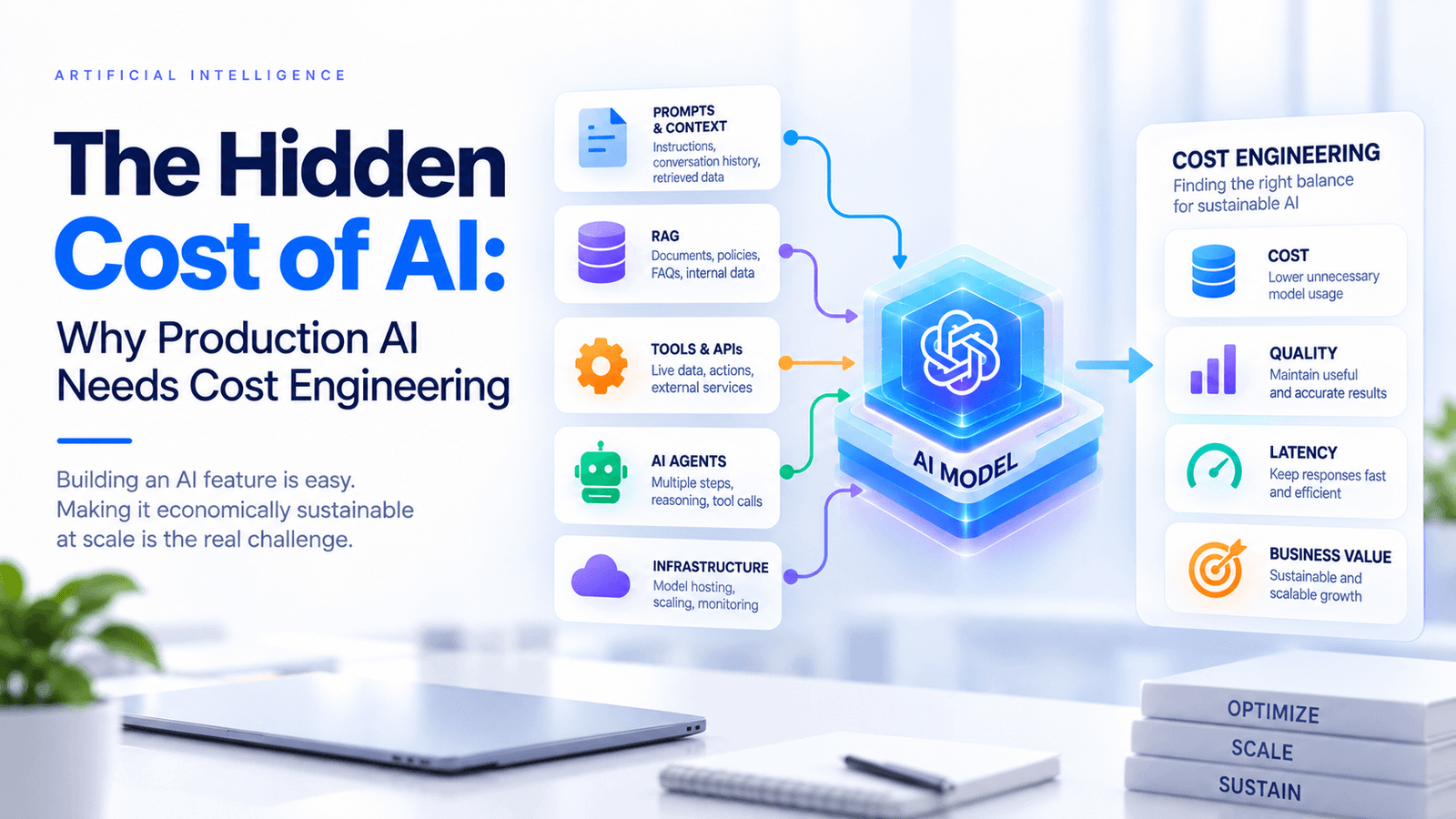
Cost and Complexity Considerations
One of the biggest mistakes businesses make is assuming that AI should replace every automated process.
In reality, AI agents often introduce additional complexity.
They require:
AI models
Prompt management
Monitoring
Testing
Usage costs
Security considerations
Traditional automation is usually simpler to maintain because the workflow follows predefined rules.
For many businesses, investing in AI for a process that could be handled by standard automation creates unnecessary complexity and cost.
The goal should never be to use AI because it's trendy.
The goal should be to use the right solution for the problem.
The Best Approach Is Often a Combination of Both
Many of the most effective business systems combine traditional automation and AI agents.
For example, imagine a visitor starts a conversation with an AI assistant on your website.
The AI agent can answer questions, understand project requirements, and collect important information.
Once the conversation is complete, traditional automation can take over.
The collected information can be:
Added to a CRM
Assigned to the appropriate team member
Stored in a database
Sent through email notifications
Included in internal reports
The AI handles the conversation.
The automation handles the process.
Together, they create a more efficient workflow.
What Should Businesses Invest In?
There is no universal answer.
Businesses that struggle with repetitive manual tasks often see immediate benefits from traditional automation.
Businesses that need intelligent interactions, decision support, or more natural customer experiences may benefit from AI agents.
For many organizations, the smartest investment is not choosing one over the other. It's understanding where each technology fits within the business.
Automation provides structure and consistency.
AI provides flexibility and intelligence.
When used together, they can help businesses save time, improve efficiency, and create better experiences for both customers and employees.
Final Thoughts
AI agents are generating a lot of excitement, and for good reason. They open new possibilities for how businesses interact with customers, manage information, and support decision-making.
However, traditional automation remains one of the most valuable technologies available to businesses today.
The real opportunity isn't replacing automation with AI.
It's combining both in a way that solves real business problems.
Before investing in any new technology, focus on the outcome you want to achieve. The right solution isn't always the newest one. It's the one that delivers the most value for your business.
As AI continues to evolve, businesses that understand when to automate and when to apply intelligence will be in the strongest position to grow, adapt, and compete.
Share this article